
In the modern digital landscape, off-the-shelf software often acts as a bottleneck rather than a catalyst for growth. While commercial software solutions are designed to cater to a broad audience, they frequently lack the specific features or integration capabilities that unique businesses require. Custom build software represents a strategic pivot toward efficiency, allowing companies to engineer digital environments that fit their specific operational workflows rather than forcing their operations to adapt to rigid software templates. By investing in tailored solutions, organizations can address precise pain points, automate proprietary processes, and gain a competitive edge that generic software simply cannot provide.
The Strategic Value of Custom Development
The primary argument for opting for custom build software is scalability. Commercial platforms are notorious for forcing businesses to purchase bloated packages containing features that go unused, while simultaneously lacking critical functionality necessary for specific niches. Custom software is built with the company’s future in mind, meaning developers can architect systems that are modular and ready to scale alongside growth. This alignment ensures that as the business expands, the underlying technical infrastructure remains robust and capable, avoiding the common pitfalls of forced migration or costly re-platforming exercises that occur when standard software finally hits its limits.
Furthermore, custom software enhances operational security. When an organization utilizes mass-market software, they share a common vulnerability profile with every other user of that platform. Hackers familiar with a widely used platform's exploits can easily target multiple companies. Conversely, a custom solution provides an obfuscated environment that is far less attractive to broad-spectrum cyberattacks. By integrating rigorous security protocols during the design phase, companies can ensure their data protection measures are bespoke and compliant with specific industry regulations, such as ISO 27001 standards, rather than relying on generic security updates that may or may not cover their specific architectural needs.
Evaluating the Build-versus-Buy Decision
Deciding to build rather than buy is not merely a financial calculation; it is a long-term commitment to operational autonomy. Companies often find that while the initial outlay for custom software appears higher than a monthly subscription fee, the total cost of ownership over a five-to-ten-year period often favors the custom build. This is especially true when considering the hidden costs of productivity loss associated with sub-optimal off-the-shelf tools. Data suggests that companies often underestimate the impact of software efficiency; improving workflow automation through custom tools can significantly reduce the manual labor hours spent on repetitive tasks, providing a high return on investment.
- Unique Business Processes: Are your operations significantly different from your competitors?
- Integration Requirements: Does the software need to talk to proprietary legacy systems?
- Long-term Strategy: Is this software a core component of your competitive advantage?
- Compliance Needs: Does your industry require specific, non-standard security protocols?
- User Experience: Do your employees require a highly specific interface to maximize their productivity?
The Lifecycle of Custom Software Projects
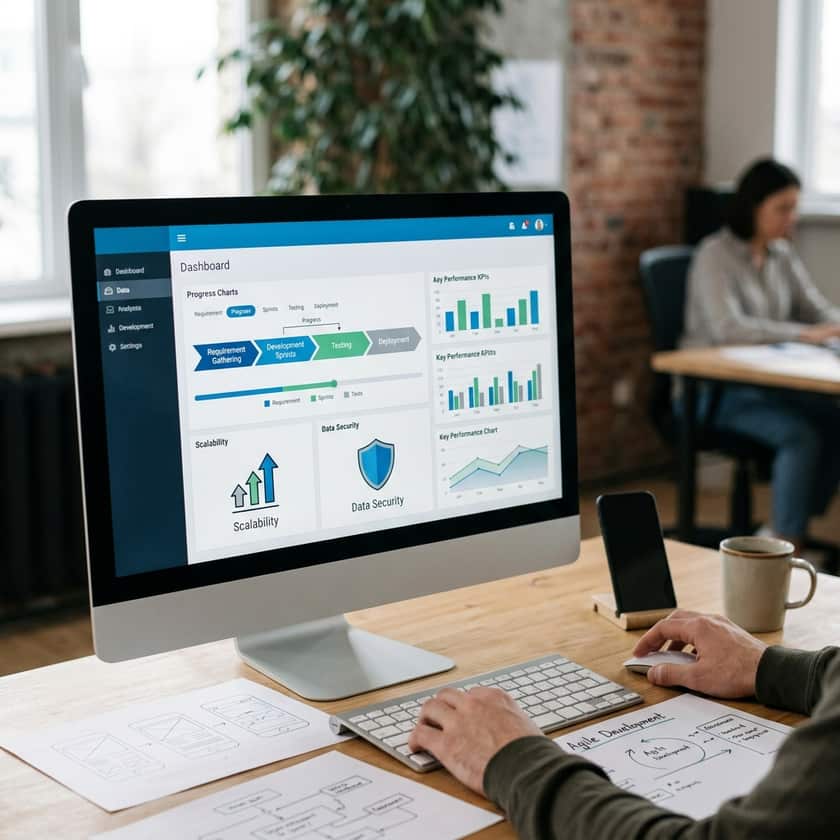
A successful custom software project requires a structured lifecycle that prioritizes communication and iterative improvement. It begins with a deep discovery phase, where developers immerse themselves in the business's requirements. This phase is crucial because it aligns the technical roadmap with actual business outcomes. Following discovery, the development team shifts into an agile cycle—coding, testing, and reviewing in sprints. This methodology prevents the 'waterfall' trap where large chunks of time and money are spent before seeing any working product. Instead, stakeholders interact with incremental builds, providing feedback that ensures the final product aligns perfectly with the initial business requirements.
Post-deployment support is the final, often overlooked stage. Custom software is never truly 'finished' because the business environment is dynamic. As market conditions shift or new data privacy laws emerge, the software must evolve. This ongoing maintenance is the key advantage of owning your codebase. Unlike a vendor-locked SaaS product where you are at the mercy of their roadmap and feature updates, a custom build grants you full control over when to update, what features to prioritize, and how to adapt your digital infrastructure to changing internal or external demands.
Mitigating Risks in Custom Development
The perception that custom software is 'risky' is largely a product of poor project management rather than inherent technical failure. To mitigate these risks, organizations should prioritize transparency and rigorous testing. This involves implementing automated testing suites from the earliest stages of development, ensuring that new code does not break existing, stable functionality. Furthermore, choosing a development partner or team that emphasizes documentation ensures that the knowledge base regarding how the system works remains with the organization, preventing 'vendor lock-in' even if you utilize an external firm to build your solution initially.
Risk management also includes financial planning. Always account for the 'hidden' costs of development, such as employee training, data migration from legacy systems, and ongoing server or cloud infrastructure maintenance. By preparing for these operational costs upfront, business leaders can ensure that the project is adequately funded through to completion, avoiding the common scenario where a project is launched half-finished due to budget overruns. Ultimately, a custom software project should be managed like any other high-stakes capital investment: with clear KPIs, milestones, and a focus on long-term value generation.