
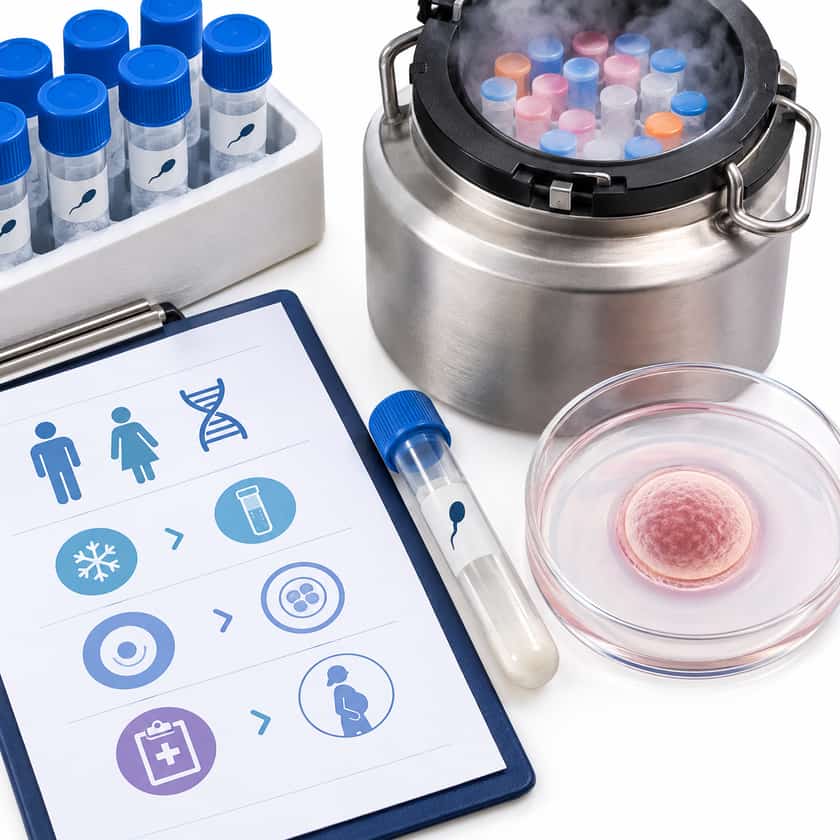
Understanding the Structural Complexity of Donor Gamete Procurement
Navigating third-party reproduction frequently presents logistical and clinical hurdles that generic medical pathways fail to address. Prospective parents and prospective donors often encounter fragmented systems where biological variables, legal contracts, and stringent cryopreservation standards intersect. The failure of off-the-rack fertility planning rarely stems from individual biological limitations; rather, it reflects a structural misalignment between clinical expectations and administrative supply chains.
Procuring human gametes requires an uncompromising chain of custody, genetic compatibility mapping, and adherence to rigid biosecurity frameworks. When intended parents treat donor procurement as an ordinary commercial transaction or prospective donors view it merely as casual compensation, essential considerations such as post-thaw survival rates, cytomegalovirus (CMV) compatibility, and directed-donor legal rights become obscured. Understanding third-party reproduction demands looking past superficial marketing and analyzing regulatory compliance, laboratory certification, and clinical logistics.
Scenario-Based Solutions and Clinical Pathways
Donor Compensation and Locating Facilities
Individuals evaluating donor programs frequently research prospective earnings alongside local options. When searching for Sperm Donation Money, candidates often assume that compensation is paid immediately upon biological deposit. In practice, clinical compensation is delayed due to obligatory multi-stage infectious disease screening. Regulatory bodies such as the United States Food and Drug Administration (FDA) enforce a mandatory six-month quarantine under 21 CFR Part 1271 for anonymous samples to eliminate viral incubation risks before specimens can be released for clinical use.
Eligibility Timeline:
Phase 1: Semen Analysis & Initial Screen (Weeks 1-2)
Phase 2: Genetic & Infectious Panel (Weeks 3-6)
Phase 3: Active Production Protocol (Months 2-6)
Phase 4: Quarantine Release Testing (Month 12)
For those seeking a certified Paid Sperm Bank Near Me, informal peer-to-peer arrangements or unregulated community matching often look appealing due to their low barriers to entry. However, private arrangements lack systematic pathogen screening, carry uncertain legal custody liabilities, and provide no objective verification of sample motility. Licensed facilities—such as California Cryobank, Fairfax Cryobank, and Seattle Sperm Bank—maintain strict acceptance rates, typically under 2%, screening for carrier status across hundreds of recessive monogenic conditions while guaranteeing donor identity disclosure policies that comply with American Society for Reproductive Medicine (ASRM) guidelines.
Evaluating Gamete Expenses and Local Clinical Infrastructure
Intended parents beginning their treatment journey must calculate the granular Cost of Donor Sperm. Commercial pricing is not simply the raw biological specimen cost; it reflects post-thaw motile cell concentration guarantees, quarantine maintenance, and micro-shipping logistics. A single vial of washed, intrauterine-insemination-ready (IUI) sperm generally ranges between $1,000 and $1,600, excluding nitrogen dry-shipper container rental fees, transfer insurance, and clinic intake administration charges.
Attempting to cut corners by purchasing unwashed specimens (ICI) for home insemination without medical monitoring leads to lower cycle fecundity and risks anaphylactoid uterine reactions if unwashed samples are placed intracervically. When selecting an accredited Sperm Clinic Near Me, patients must ensure that the receiving clinical embryology laboratory operates under Clinical Laboratory Improvement Amendments (CLIA) certification or College of American Pathologists (CAP) accreditation. These institutions verify liquid nitrogen dewars upon arrival, assess temperature logging slips, and perform rapid post-thaw semen analyses before intra-uterine or in-vitro execution.
Advanced Procurement: Oocyte Economics and Combined Protocols
When third-party gamete needs extend beyond donor sperm, financial and medical complexity increases significantly. The total Donor Egg Cost substantially exceeds sperm banking fees due to the intensive medical interventions involved. Procuring a cohort of 6 to 8 frozen donor oocytes typically commands between $14,000 and $22,000 for the donor bank fee alone, while fresh donor cycles frequently surpass $35,000 when factoring in ovarian stimulation medications, cycle monitoring, egg retrieval surgery, and donor legal representation.
For patients confronting both severe male and female factor infertility, advanced maternal age, or single individuals and same-sex couples seeking biological detachment from both lineages, Double Donation Ivf provides a viable clinical solution. This protocol pairs donor oocytes with donor sperm to produce blastocysts in vitro. Quick-fix alternatives—such as unvetted private donor arrangements across borders—risk unexpected genetic mutations, legal parentage litigation, and absent embryology records. Certified clinics reporting data to the Society for Assisted Reproductive Technology (SART) provide documented blastocyst formation guarantees, rigorous pre-implantation genetic testing for aneuploidies (PGT-A), and transparent clinic-level success data.
Granular Breakdown & Comparison Matrix
The following matrix outlines the operational, financial, and clinical variables across major donor gamete acquisition paths.
| Strategy / Option | Price/Cost Range | Structural/Technical Efficiency | Common Hidden Pitfalls / Traps | Ideal Use-Case Scenario |
|---|---|---|---|---|
| Certified Commercial Sperm Bank | $1,000 – $1,800 per vial (plus $250–$400 shipping) | High; verified minimum 10–20 million Total Motile Cells (TMC) post-thaw | Family unit limits exceeded; unexpected annual storage fees | Single parents by choice, lesbian couples, or severe male factor infertility |
| Frozen Oocyte Bank Cohort | $14,000 – $24,000 per cohort (6–8 eggs) | Moderate to High; ~85–90% thaw survival rate under vitrification | Blastocyst attrition; zero viable blastocysts from low-yield cohorts | Female factor infertility, advanced maternal age with viable partner sperm |
| Fresh Synchronized Donor Egg Cycle | $30,000 – $50,000+ per completed cycle | Maximum egg yield (15–25+ oocytes); high blastocyst conversion | Cancellation risk due to poor donor stimulation response | Families requiring large sibling cohorts or specific phenotypic matching |
| Double Donation IVF Protocol | $20,000 – $40,000 complete clinical cycle | High efficiency when combining vitrified donor cohorts with pre-screened sperm | Complex multi-party contracts; genetic carrier overlap between donors | Severe combined infertility, absence of gametes, or recurring embryo arrest |
Critical Technical and Structural Decision Parameters
- Total Motile Sperm (TMS) Count and Preparation Format: Intended parents must distinguish between Intrauterine Insemination (IUI) preparations, Intra-Cervical Insemination (ICI) samples, and In Vitro Fertilization / Intracytoplasmic Sperm Injection (IVF/ICSI) units. IUI specimens undergo density-gradient centrifugation to eliminate seminal plasma, bacteria, and prostaglandins, leaving an isolated pellet of motile cells (guaranteed between 10 and 20 million TMS per milliliter depending on bank tier). Utilizing ICI specimens in an intrauterine procedure without clinic-level washing can trigger severe uterine cramping and systemic anaphylactoid shock.
- Expanded Genetic Carrier Screening Synchronization: When utilizing donor sperm alongside patient oocytes, or during double donation cycles, genetic screening must not occur in isolation. Modern donor panels analyze 280 to 500+ autosomal recessive and X-linked conditions using next-generation sequencing. Intended parents must cross-reference their personal genetic carrier profile with the donor's panel to confirm zero intersection across recessive mutations (such as Cystic Fibrosis, Spinal Muscular Atrophy, or Fragile X mutations).
- Cytomegalovirus (CMV) Serostatus Compatibility: CMV is a prevalent herpesvirus that poses severe congenital risks to a developing fetus if primary maternal infection occurs during pregnancy. A CMV-negative recipient should balance their search toward CMV IgG/IgM negative donors. Opting for a CMV-positive donor when the gestational carrier is CMV-negative introduces potential viral reactivation hazards, requiring rigorous specialist clearance.
Practical Vendor & Purchase Action Plan
Gamete Verification Checklist
- [ ] Verify Regulatory Filings: Confirm that the sperm or egg bank maintains an active, unflagged registration with the FDA (Center for Biologics Evaluation and Research) and holds state-level tissue bank licenses (such as California, New York, and Maryland tissue banking permits).
- [ ] Audit the Medical History Hierarchy: Ensure the donor profile includes at least a three-generation pedigree charting physiological diseases, cardiovascular health, mental health conditions, and cancer incidence.
- [ ] Examine Post-Thaw Motility Guarantees: Check the facility’s refund and credit policy for vials that fall below minimum technical standards (e.g., less than 10 million motile cells per ml at 0.5 ml volume after standardized thaw).
- [ ] Review Identity Disclosure Classifications: Identify whether the gamete donor is registered as "Identity Release at 18" (open-ID) or "Anonymous/Non-Disclosed," confirming that legal donor non-paternity agreements are executed in accordance with local uniform parentage laws.
Clinical Consultation Script
When meeting with fertility specialists, laboratory directors, or donor coordinators, use these targeted diagnostic questions:
- "What is your laboratory's documented post-thaw survival rate for frozen oocytes or cryopreserved sperm samples received from out-of-network distribution banks?"
- "If an acquired donor vial fails to meet the bank's guaranteed minimum total motile sperm count upon thaw in your embryology lab, what documentation do you provide to facilitate a vendor replacement credit?"
- "How does your clinical protocol verify that the intended mother's or intended surrogate's CMV serology status matches the donor's immunological profile safely?"
- "What specific genetic matching platform do you use to cross-reference my carrier screening panel against the prospective donor's genetic report to prevent compound recessive risks?"