
As organizations approach the 2026 horizon, the integration of Artificial Intelligence (AI) virtual agents has shifted from an experimental technology to a core operational mandate. The rapid evolution of natural language processing and generative models has enabled companies to move beyond the limitations of basic rule-based chatbots. Today, virtual agents are designed to handle complex, intent-driven conversations that were previously reserved for human interaction. This shift is not merely about cost cutting; it represents a fundamental change in how businesses approach customer availability, providing 24/7 support while ensuring that human resources are dedicated to the most sensitive and high-value inquiries.
The Shift Toward Intelligent Automation
The primary driver for the adoption of AI virtual agents leading into 2026 is the growing pressure to balance operational efficiency with rising customer expectations. Modern consumers demand instant, accurate, and context-aware responses regardless of the time of day. Organizations that rely solely on legacy systems are finding themselves overwhelmed by high contact volumes and rising labor costs. By deploying advanced virtual agents, businesses can automate approximately 60% to 65% of routine customer interactions. This automation is not a replacement for human staff but a significant relief mechanism, allowing the workforce to pivot from rote data entry or FAQ answering toward complex problem solving, brand building, and customer retention strategies.
Operational Metrics and Efficiency Gains
| Metric | Pre-AI Baseline | Post-AI Performance | Efficiency Impact |
|---|---|---|---|
| Avg. Handling Time (AHT) | 100% (Baseline) | 50% - 70% | 30% - 50% Reduction |
| Cost Per Interaction | $7.75 | $6.00 | ~$1.75 Savings |
| First Call Resolution | 40% | 70% | Significant Increase |
| Task Automation Rate | Low | 63% | Routine Relief |
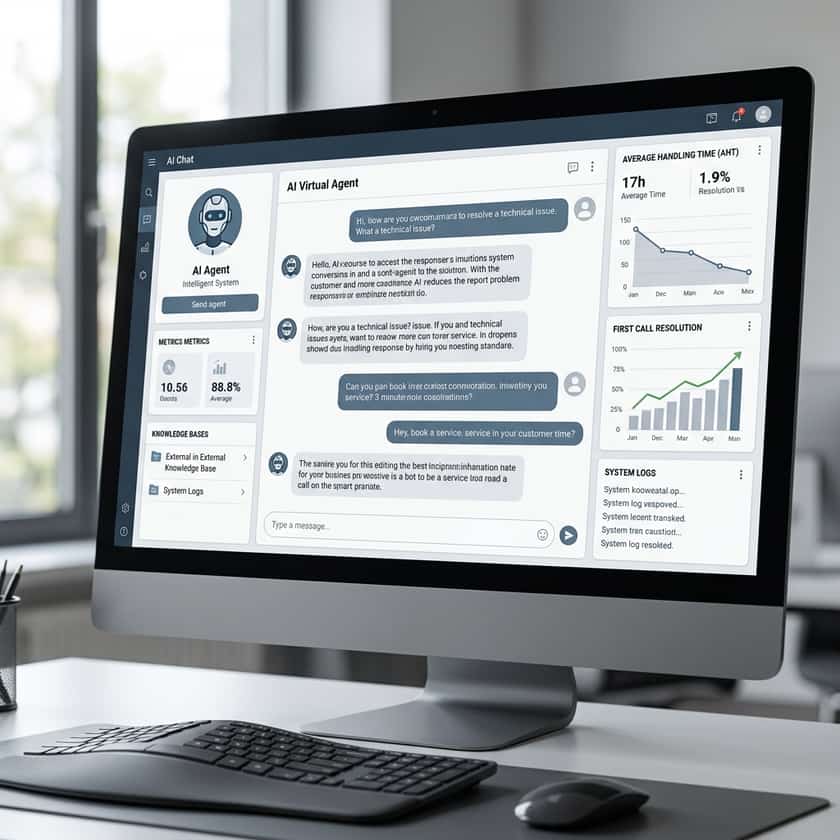
As indicated in the operational data, the reduction in Average Handling Time (AHT) is a critical performance indicator. When virtual agents manage the initial phase of an inquiry, they can rapidly pull data, verify credentials, and triage the issue. This allows human agents to pick up conversations that are already framed with context, significantly reducing the 'discovery' phase of the call. Furthermore, the financial impact—often measured in dollar savings per interaction—can scale rapidly when applied to high-volume contact centers. By removing the burden of repetitive, low-value tasks, companies can redirect those financial resources into agent training, better software tools, and improved product development.
Addressing Agent Burnout and Retention
A frequently overlooked aspect of AI adoption is its impact on the human workforce. Contact center environments are notorious for high turnover rates, often driven by the monotony of answering identical questions repeatedly. AI virtual agents serve as a buffer against this burnout. By offloading 63% of high-frequency, routine queries, human agents are freed from the mental fatigue associated with repetitive work. Instead, they handle nuanced escalations that require empathy and critical thinking. This shift improves the overall employee experience, leading to higher job satisfaction and lower attrition rates, which in turn saves companies the substantial costs associated with recruiting and training new personnel.
Best Practices for 2026 Implementation
- Prioritize Data Integration: Ensure the virtual agent has secure, real-time access to CRM systems to provide personalized service.
- Human-in-the-Loop Design: Build seamless escalation paths so that a human agent can intervene instantly if the AI encounters an unresolvable issue.
- Continuous Learning Loops: Treat the AI agent as a living system that requires frequent feedback, retraining, and updates based on real customer interaction logs.
- Define Clear Success Metrics: Beyond cost savings, measure customer sentiment and first-resolution success to gauge the quality of the interaction.
- Transparency by Design: Always inform the user they are speaking with an AI, which helps manage expectations and improves satisfaction with the transparency of the interaction.
The Long-Term Outlook
Looking ahead to 2026 and beyond, the capability gap between 'basic' automated support and 'intelligent' virtual agents will continue to widen. The focus will likely shift toward multimodal interactions, where virtual agents can analyze not just text or voice, but also visual context shared by customers via smartphone cameras. Furthermore, cross-departmental integration will become the norm. Virtual agents will not just be siloed in the help desk; they will act as orchestrators, connecting to inventory systems, shipping logistics, and financial databases to provide holistic solutions. Organizations that begin their integration journey now, focusing on clean data architecture and user-centric design, will be best positioned to lead their respective markets.