
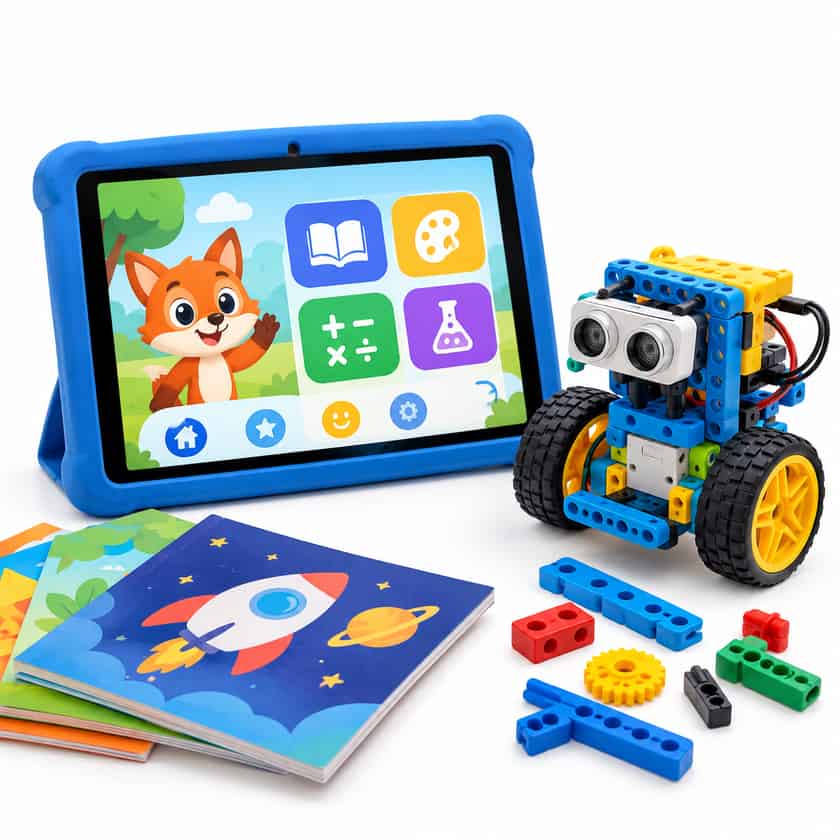
Rethinking Safe Early Childhood Education Platforms
Many parents find that off-the-shelf digital tools and standard educational media fail to deliver a constructive learning experience. The frustration is rarely due to a child's short attention span or an inability to focus. Rather, it stems from a systemic mismatch between product design and child psychology. Commercial applications are routinely engineered around behavioral engagement loops, bright sensory overload, and disguised microtransactions rather than cognitive development. These environments prioritize active screen retention over genuine educational milestones, leaving children stimulated yet cognitively unguided.
When modern families seek digital or physical learning tools, they face safety threats ranging from ad-tracking networks to algorithmically driven unvetted content. Generic learning subscriptions often compromise either strict data privacy or developmental quality. Solving this tension requires viewing early education through the combined lens of rigorous data privacy frameworks, cognitive developmental milestones, and age-calibrated instructional design. The objective is to establish an engaging, predictable space where self-directed discovery can thrive without behavioral traps or data harvesting.
Scenario-Based Solutions Aligned with Learning Needs
Safe Online Learning Platforms for Kids
Parents navigating early digital schooling often worry about unsolicited advertising, algorithmic auto-play loops, and intrusive data tracking. The typical quick fix—handing a child a general video platform with standard adult parental controls enabled—invariably fails. These algorithmic systems rely on automated keyword filters that routinely misclassify inappropriate content or funnel young users toward commercial dopamine loops designed for user retention.
To establish authentic educational integrity, parents must demand adherence to rigorous regulatory standards. A secure platform must comply strictly with the Children's Online Privacy Protection Act (COPPA) in the United States, obtain independent kidSAFE Seal Program certification, and implement the Family Educational Rights and Privacy Act (FERPA) guidelines where school records integrate. Closed-garden platforms eliminate external social mechanics and behavioral profile generation entirely.
Leading benchmarks in this domain include ABCmouse by Age of Learning, PBS KIDS Games, and Khan Academy Kids. These services utilize zero-advertisement architecture and rely on research-based early reading and math curricula developed with early childhood specialists. When evaluating safe platforms, verify that the infrastructure prohibits unmoderated user chat, third-party data tracking pixels, and in-app storefront links, thereby safeguarding young learners from commercial interference.
Interactive Early Childhood Educational Apps
Families often struggle with low-quality, gamified applications that claim educational benefits while merely testing reflex speed through frantic screen tapping. Common DIY remedies, such as downloading freemium puzzle games, backfire. These games introduce frustrating paywalls, display deceptive reward mechanisms, and induce overstimulation without reinforcing literacy or numeracy retention.
Effective digital interfaces for children aged two through eight must adhere to the American Academy of Pediatrics (AAP) interactive media recommendations. Look for applications offering a balanced 1:1 active-to-passive response ratio, where screen feedback requires thoughtful physical interaction, critical vocal repetition, or concrete spatial problem-solving rather than mindless swiping. Furthermore, look for compliance with Universal Design for Learning (UDL) principles, which support multi-sensory feedback and customizable audio pacing.
Industry benchmarks such as Duolingo ABC, Sago Mini World, and Toca Life demonstrate how open-ended exploratory play promotes cognitive resilience. These products emphasize agency, deliberate decision-making, and intrinsic curiosity rather than extrinsic point scoring. High-caliber educational applications feature isolated parent dashboards that report skill mastery through developmental rubrics instead of time-on-app metrics.
Joyful STEM Learning Kits for Children
Transitioning from digital immersion to hands-on manipulation often frustrates parents when prefabricated craft boxes fail to hold a child's interest. The usual improvised fix—purchasing random craft supplies or cheap plastic science novelties—fails because these lack a progressive educational curriculum. They result in one-off novelty experiments that break easily and offer zero scaffolding for independent mechanical reasoning.
High-yield physical learning environments require materials manufactured according to strict safety standards, notably ASTM International F963 consumer safety specifications and non-toxic certification under European EN71 guidelines. Sustainable wooden components, food-grade silicone, and precision-engineered mechanical linkages yield the tactile durability necessary for exploratory trial-and-error play. A scientifically designed kit balances structured instruction with open-ended invention, teaching iterative problem-solving alongside core engineering principles.
Benchmark providers such as KiwiCo (specifically the Koala and Kiwi Crate tiers), Osmo (which bridges physical manipulatives with tablet sensors), and LEGO Education Early Learning sets illustrate effective multimodal instruction. These systems engage fine motor development and foundational spatial-temporal skills through tactile, repeatable engineering challenges that build confidence alongside joy.
Technical Evaluation and Strategy Comparison
Selecting the right balance of digital tools, physical manipulatives, and hybrid learning environments requires assessing structural efficacy against cost:
| Strategy / Option | Price/Cost Range | Structural/Technical Efficiency | Common Hidden Pitfalls / Traps | Ideal Use-Case Scenario |
|---|---|---|---|---|
| Pure Closed-Ecosystem Digital Subscriptions | $8 – $15 monthly recurring | High curricular scaffolding; zero ad vulnerability; automated progress reporting | Subscription fatigue; potential over-reliance on screen time; variable offline functionality | Independent foundational phonics, literacy, and mathematical skill reinforcement at home |
| Hybrid Physical-Digital Manipulative Systems | $80 – $160 initial hardware + $30 – $60 kit add-ons | Superior spatial-cognitive translation; bridges tangible play with responsive digital feedback | Camera alignment errors; hardware obsolescence; requires high adult onboarding initially | Children who struggle with purely abstract screen tasks and require tangible feedback |
| Curated Monthly Hands-On STEM Subscriptions | $20 – $40 per monthly delivery | Outstanding tactile engineering practice; zero screen exposure; real-world problem solving | Material accumulation; variable completion interest; single-use project components | Fostering parent-child collaborative projects and kinesthetic problem-solving routines |
| Open-Ended Structured Analog Building Frameworks | $40 – $120 one-time purchase | Maximum longevity; exceptional multi-age durability; fosters geometric intuition | Requires dedicated physical storage; lacks self-correcting instructional cues | Long-term unstructured creative play, spatial visualization, and independent resilience building |
Beyond cost comparisons, parents must systematically inspect three critical technical parameters:
- Feedback Latency and Cognitive Pacing: Quality educational software maintains an interface response latency between 50 and 150 milliseconds. Immediate auditory or visual affirmation confirms a child's action, while deliberate delay intervals (1 to 2 seconds) between questions prompt genuine reflection, preventing rapid trial-and-error guessing.
- Material Toxicity and Durability Ratings: For physical manipulatives, demand verifiable compliance with ASTM F963-17 standards, ensuring zero lead content, phthalate concentrations below 0.1%, and drop-impact resistance capable of withstanding repeated 3-foot falls onto uncarpeted flooring without splintering.
- Data Portability and Telemetry Transparency: Secure digital platforms provide fully exportable learning history profiles (via CSV or standard JSON formats) alongside transparent, opt-out toggles for crash analytics, guaranteeing that personal identifiers, biometric voice data, and device location remain strictly unmonitored.
Practical Vendor & Purchase Action Plan
Physical and Digital Verification Checklist
- Privacy and Certification Audit: Check the platform footer or packaging for verified third-party seals, including the kidSAFE Seal, PRIVO certification, or explicit COPPA safe-harbor compliance documentation.
- Monetization and Advertising Scan: Confirm that the application contains no embedded third-party ad banners, sponsored product placements, direct external web hyperlinking, or predatory in-app currency stores.
- Material Safety Verification: For physical kits, inspect all component stamps to confirm non-toxic ASTM F963 or EN71 certifications, reinforced battery compartments requiring a screwdriver, and the absence of small-part choking hazards for under-three age tiers.
- Curricular Accountability: Verify that learning pathways reference established foundational benchmarks, such as Head Start Early Learning Outcomes Framework or state-level early learning standards.
Strategic Questions for Vendor and Support Representatives
- How does your software capture, store, and purge my child's voice recordings, drawing inputs, and behavioral performance metrics?
- Are software updates included in the original purchase price, or are core developmental modules gated behind recurring microtransactions and expansion packs?
- What specific empirical research, academic partnerships, or child development certifications informed the pedagogical sequence of this curriculum?
- What structural fallback options, such as complete offline access modes, exist if our family chooses to disconnect the device from home broadband?