
Evaluating the Risk and Reward of Pre-Owned Wheels
Upgrading your vehicle's stance or replacing a damaged wheel shouldn't have to drain your entire bank account, which makes the pre-owned market highly attractive to budget-conscious motorists. On platforms like online marketplaces and local classifieds, premium aftermarket alloy wheels frequently list for a mere fraction of their original retail cost. However, a flawless exterior finish can easily mask internal structural flaws, incorrect dimensions, or fatigue from past high-speed impacts. Navigating this unregulated marketplace safely requires moving past pure aesthetic appeal and understanding the exact mechanical interface between the wheel, the hub, and the suspension geometry. Before handing over any cash to a stranger, buyers must arm themselves with precise measurements and an empirical, multi-point inspection strategy to avoid catastrophic road failures.
The Five Essential Fitment Dimensions
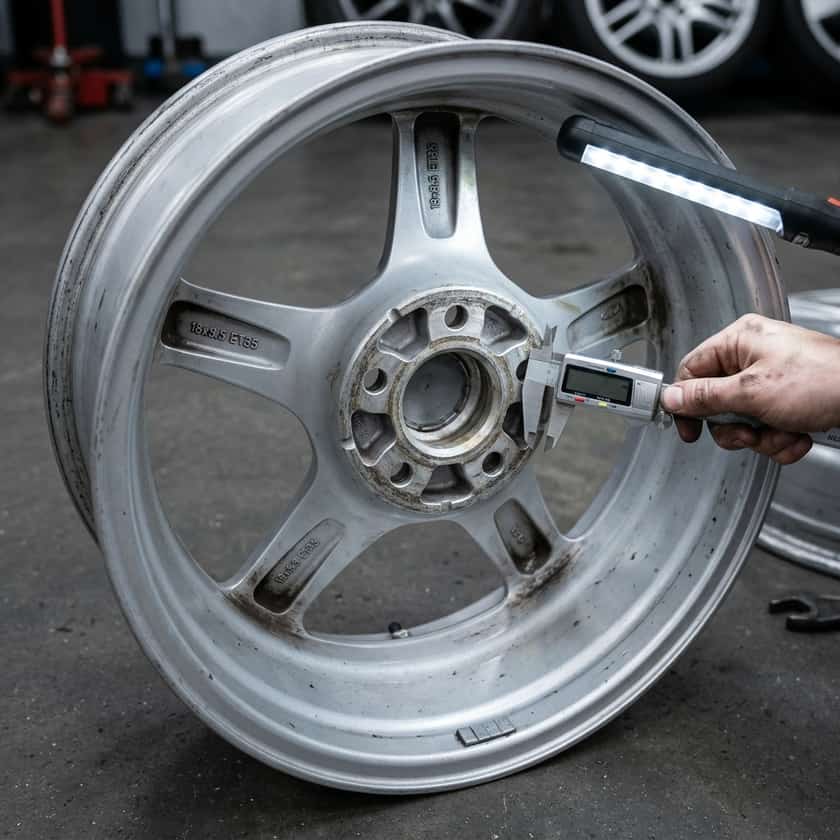
For any replacement wheel to operate safely, five distinct measurements must align perfectly with your vehicle's specific factory dimensions. First is the pitch circle diameter, commonly known as the bolt pattern, which is non-negotiable and cannot be altered safely without dangerous hub adapters. Second, the center bore must match your vehicle's hub size; a larger wheel bore requires hub-centric spacer rings to prevent high-speed steering wheel vibrations, while a smaller bore simply won't seat on the hub. Third, the offset determines how far inward or outward the wheel sits inside the fender well. Fourth, the rim width dictates tire compatibility, and fifth, the overall diameter impacts odometer accuracy and brake caliper clearance. Ignoring even one of these figures can lead to severe tire rubbing, rapid suspension wear, or unsafe brake caliper interference.
| Dimension | What It Measures | Safe Tolerance | Incorrect Fitment Symptom |
|---|---|---|---|
| Bolt Pattern (PCD) | Number of lugs and diameter of the mounting circle | Zero tolerance; must match exactly | Inability to mount the wheel safely |
| Center Bore | The diameter of the center hole of the wheel | Can be larger if using hub-centric rings | Severe steering wheel vibration at highway speeds |
| Offset (ET) | Distance from the mounting surface to the wheel centerline | Typically within 5-10mm of OEM spec | Tire rubbing against fenders or suspension struts |
| Rim Width | The distance between the inner tire-beating flanges | Must align with approved tire section widths | Poor tire bead seating or stretched tire tread |
| Brake Clearance | Physical space between the spokes and the brake caliper | Minimum of 3mm of clear space is recommended | Caliper scraping or complete wheel lockup |
In-Person Inspection Protocol
- Examine the inner barrel for hairline cracks, especially along the rear lip where impact damage most frequently occurs.
- Check for evidence of previous weld repairs, which compromise the metallurgical integrity of the alloy.
- Lay the wheel face down on a flat surface or spin it on a balancing machine to verify there is no lateral or radial runout.
- Measure the depth of any curb rash to ensure it is purely cosmetic and has not gouged deep enough to weaken the outer flange.
- Verify that the lug seats are perfectly round and have not been ovalized by over-torqued lug nuts.
- Look up the stamped markings on the back of the spokes to verify the load rating matches or exceeds your vehicle's gross axle weight rating.
The manufacturing process of the wheel heavily influences its long-term durability and repairability on the second-hand market. Traditional cast wheels are the most common and affordable options, but they are relatively brittle and highly prone to cracking under heavy pothole impacts. Flow-formed wheels offer a much stronger barrel section, while fully forged wheels provide the ultimate tensile strength along with significant unsprung weight savings. When evaluating a used forged wheel, expect a higher price point but also a much lower likelihood of hidden structural fatigue cracks. However, because forged wheels are exceptionally rigid, severe impacts can still bend them without cracking, meaning an in-person spin test remains absolutely mandatory regardless of the premium construction pedigree or high-end brand name.
Navigating Price Tiers and Red Flags
Pricing in the used market generally correlates with construction and brand reputation. Entry-level cast rims and original equipment manufacturer (OEM) takeoffs typically trade for a couple hundred dollars per set, making them excellent budget replacements. Mid-tier flow-formed options command a slight premium but offer superior strength-to-weight ratios for enthusiast driving. Be exceptionally wary of listings priced far below these market averages, as they often point to replica wheels constructed with inferior alloy mixtures that fail catastrophically under heavy cornering loads. If a deal seems too good to be true, always ask the seller for the original retail invoice or detailed photos of the safety stamps inside the barrel to confirm authenticity and load limits.
Special Fitment Rules for Lifted Vehicles and Trucks
Truck and off-road enthusiasts face unique challenges when sourcing pre-owned wheels, as lifted suspensions completely alter clearance dynamics and steering angles. Beyond the basic bolt patterns—which are often heavy-duty six or eight-lug configurations—you must pay close attention to backspacing. Incorrect backspacing can cause wide off-road tires to rub against aftermarket control arms, sway bars, or inner fender liners during tight turns. Furthermore, trail-ready wheels require exceptional load ratings to handle heavy payloads, towing tasks, and the extreme lateral forces experienced when climbing over obstacles or airing down tires on rugged terrain. Always cross-reference the wheel's maximum load rating with your vehicle's maximum loaded weight before making an offer.
Deciding When to Walk Away
Ultimately, the decision to buy pre-owned wheels hinges on your personal risk tolerance and the transparency of the seller. If a seller refuses to let you inspect the wheels in person, spin them on a tire balancer, or provide high-resolution photos of the inner barrels, walk away immediately. When the cost of refurbishing bent rims, buying hub-centric rings, and purchasing new mounting hardware approaches the price of a brand-new, warranted set of aftermarket wheels, the value proposition completely vanishes. Prioritizing mechanical compatibility and structural integrity over a low price tag is the only way to ensure your second-hand bargain doesn't turn into a high-speed driving hazard on the highway.