
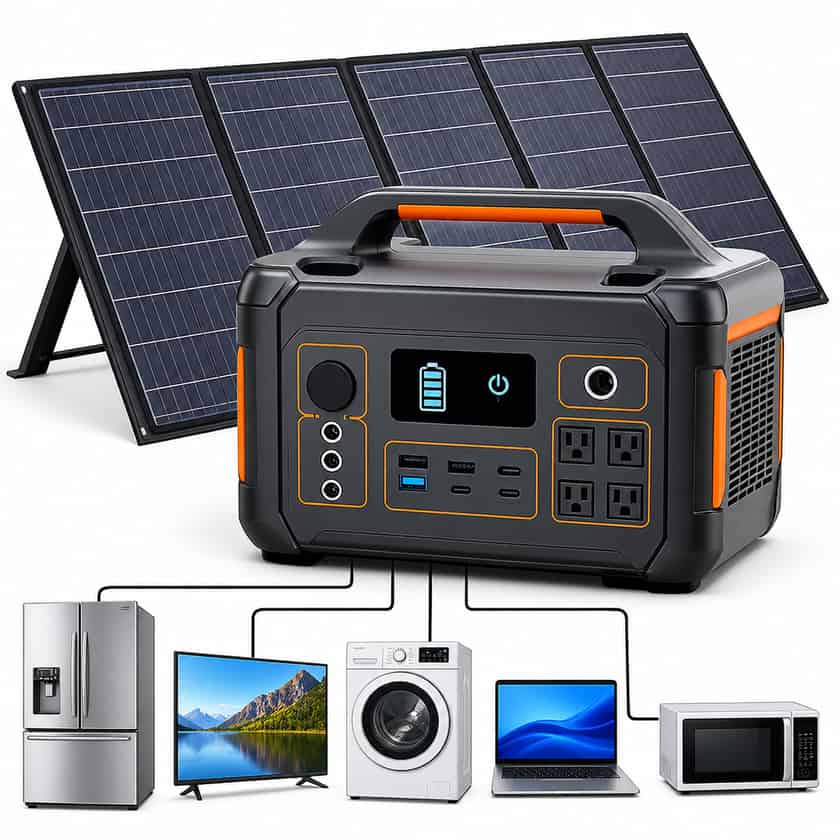
System Sizing Pitfalls and Inverter Constraints
Standard power backup systems frequently fail during critical outages not because of battery cell defects, but due to fundamental design mismatches between static AC inverters and inductive electrical surges. Conventional consumer expectations assume that a device rated for continuous operation can effortlessly manage momentary motor-start spikes. When homeowners connect heavy appliances to entry-level power stations, inverters trip instantly under the transient locked-rotor amperage of compressors and well pumps.
This discrepancy is compounded by mismatched solar harvest ratios. A substantial battery bank becomes a liability if the photovoltaic array lacks the open-circuit voltage headroom to replenish spent kilowatt-hours within limited peak sun hours. Bridging this operational gap demands transitioning from generic wattage approximations to systematic calculations of continuous run watts, peak surge thresholds, continuous duty-cycle demands, and localized solar irradiance curves.
Scenario-Based Solution Guides
Whole-Home Energy Storage and Residential Backup
Determining what solar generator can power a house begins with a strict audit of critical circuits rather than entire distribution panels. Homeowners researching a solar generator that can power a house often struggle with electrical code compliance and high-draw split-phase 240V appliances like central heat pumps. Standard plug-and-play extension cord routing creates dangerous backfeeding hazards, while manual transfer switches require dedicated neutral-ground bonding verification.
A resilient solar power backup generator for home integration must deliver at least 5,000W continuous output, 120V/240V dual-voltage capabilities, and integration with an external transfer panel compliant with National Electrical Code (NEC) 702 standards. Hybrid installations frequently combine traditional fuel platforms, where property owners evaluate products like the Briggs and Stratton 7000 watt generator battery to maintain auxiliary 12V starter charge for hybrid gas-solar failovers. In European and British markets, selecting a solar power generator for home UK residences requires compliance with G98/G99 grid interface certifications and BS 7671 wiring regulations, alongside 230V single-phase architecture.
Heavy RV and Dual-Air-Conditioner Mobile Integration
Recreational vehicle operators commonly discover that standard household 15-amp outlets cannot sustain mobile comfort systems. Connecting an RV park cord via cheap dogbone adapters repeatedly triggers thermal limits, causing inverter lockouts. Mobile users evaluating a solar generator with 30 amp rv outlet need dedicated TT-30R ports that deliver a true 3,600W continuous baseline without voltage drop.
For fifth-wheels and luxury coaches running twin rooftop climate units, locating a capable solar generator for rv 50 amp service is mandatory. These systems must provide NEMA 14-50R connections delivering split-phase 120V/240V outputs up to 12,000W peak surge. When searching for the best solar generator for rv 30 amp applications, operators should look for brands that integrate automatic neutral-floating switches to prevent false trips on onboard RV progressive surge protectors.
Off-Grid Portability, Cold-Chain Preservation, and Solar Input
Mobile field research and recreation present severe weight-to-capacity trade-offs. Novice campers often attempt to haul heavy stationary cabinets across uneven terrain, resulting in damaged casing seals and depleted transport vehicles. To recommend the best solar generators for an off grid camping trip, advisors emphasize compact lithium iron phosphate (LiFePO4) systems weighing under 35 pounds with 500W to 1,000W continuous output, integrated MPPT charge controllers, and IP65 dust/water resistance.
Food safety hinges on maintaining refrigeration during prolonged brownouts. A consumer evaluating a solar generator that can power a refrigerator must accommodate the initial 1,200W to 1,800W inductive surge of a domestic compressor, followed by an operational draw of 150W to 200W cycling at a 40% duty cycle. To sustain this load indefinitely, array sizing must match consumption. Assessing what can a 600 watt solar panel power demonstrates that in an average geographic zone yielding 4.5 peak sun hours, a 600W array produces roughly 2,160 watt-hours daily. This is sufficient to support a standard 20-cubic-foot refrigerator, LED emergency lighting, and essential communication gear.
When cross-referencing logistical timelines, buyers seeking solar generators for sale near me must balance the immediate availability of local retail stock against regional distributor warranty support, local fire marshal battery storage ordinances, and regional freight restrictions on dangerous goods class 9 lithium shipments.
Granular Breakdown and Strategy Comparison Matrix
| Strategy / Option | Price/Cost Range | Structural/Technical Efficiency | Common Hidden Pitfalls / Traps | Ideal Use-Case Scenario |
|---|---|---|---|---|
| Portable All-In-One Units | $800 - $2,200 | 85-88% inverter efficiency; integrated MPPT; limited modularity | High thermal throttling under continuous 80% loads; fixed expansion limits | Overland camping, tailgating, remote fieldwork |
| Expandable Semi-Stationary Generators | $2,500 - $5,500 | 88-92% round-trip efficiency; dual-voltage split-phase options | Proprietary battery cabling costs; elevated mass per kilowatt-hour | Extended domestic outages, 30A RV utility, cabin backup |
| Fixed Modular Home Storage | $6,000 - $14,000 | 92-95% efficiency; direct high-voltage DC solar coupling | High balance-of-system fees; permits, transfer panels, and electrician labor | Whole-house off-grid living, 50A coach loads, primary home resilience |
Critical Technical Decision Parameters
- Continuous Inverter Rating versus Inductive Surge Overhead: Pure sine wave inverters must supply an immediate 2x to 3x surge cushion above their stated continuous rating. Inductive motor loads—such as water wells, sump pumps, and HVAC compressors—demand high locked-rotor amperage for 100 to 300 milliseconds. An inverter lacking rapid-response MOSFET switching will shut down instantly to protect internal circuitry, rendering overall battery capacity useless.
- Battery Chemistry and Thermal Cycling Lifecycle: Lithium Iron Phosphate (LiFePO4) chemistries maintain stable crystalline structures across 3,500 to 6,000 cycles to 80% depth of discharge. In contrast, legacy nickel-manganese-cobalt (NMC) cells degrade within 500 to 800 cycles and exhibit higher thermal runaway risk. Industrial LiFePO4 modules equipped with active internal thermal heating pads ensure consistent charge acceptance in sub-freezing operating environments.
- Solar Charge Controller Maximum Power Point Tracking (MPPT) Voltage Windows: Solar input efficiency relies on generous VOC (open-circuit voltage) parameters. An MPPT controller with a wide voltage envelope (e.g., 12V to 150V DC) allows series string connections that minimize current loss over long wire runs. Controllers restricted to narrow, low-voltage inputs limit solar capture on overcast days, extending recharge times beyond practical daylight limits.
Practical Vendor and Purchase Action Plan
Field Inspection Checklist
- Pure Sine Wave Certification: Confirm total harmonic distortion (THD) remains below 3% under a 50% resistive load using an oscilloscope or manufacturer test sheet.
- Port Build Quality and Thermal Dissipation: Verify dedicated NEMA TT-30R or NEMA 14-50R outlets possess industrial-grade retention tension and operate beside actively cooled heatsink exhaust ports.
- Battery Management System (BMS) Diagnostic Telemetry: Ensure the unit displays real-time voltage individual cell balancing, thermistor temperature readouts, and historic error-code logging.
- Grounding and Bonding Configuration: Check whether the system features an internal bonded neutral or floating neutral, and verify the existence of an external grounding terminal screw for transfer switch integration.
Professional Consultation Script
When consulting with regional equipment distributors, electrical contractors, or system integrators, ask these precise questions before purchasing:
- Does this power station feature an internal bonded neutral or a floating neutral, and will an external transfer switch cause dual-neutral ground loops on my household sub-panel?
- What is the sustained continuous runtime limitation when discharging at 80% of rated capacity in ambient temperatures above 95°F (35°C)?
- Does the onboard MPPT solar charge controller support series-parallel PV strings with open-circuit voltages up to 150V, or does it throttle array amperage at lower input thresholds?
- In the event of an internal inverter or BMS failure, does your warranty support modular field component swaps, or does it mandate returning the entire 100-pound lithium assembly via hazardous-materials freight at the owner's expense?