
System Bottlenecks in Portable and Stationary Clean Backup
Transitioning to solar power reserves often exposes unexpected electrical vulnerabilities. Many property owners and travelers discover that basic off-the-shelf power stations collapse under surge demands, take too long to recharge, or fail under continuous loads. This friction does not stem from consumer misunderstanding; it highlights a systemic mismatch between surge-heavy alternating current (AC) appliances and undersized portable storage architecture.
Traditional gas generators push through reactive inductive spikes with heavy mechanical rotors. In contrast, portable power stations rely on solid-state inverters, lithium iron phosphate (LiFePO4) battery chemistries, and complex management systems (BMS). When buyers mismatch battery discharge C-rates, continuous inverter capacities, or solar array charging limits, systems trigger low-voltage cutoffs or cycle out rapidly. Deploying a resilient solar setup demands engineering precision rather than arbitrary capacity estimates.
Scenario-Based Engineering and System Sizing
Whole-Structure Domestic Redundancy and Sizing Realities
Navigating options when searching for a Solar Generator that Can Power a House requires isolating continuous running watts from starting surge requirements. Homeowners seeking a dependable Solar Power Backup Generator for Home often find that 2,000-watt to 3,000-watt systems trigger immediate inverter fault codes when high-draw central equipment activates. For users asking What Solar Generator Can Power a House, the technical baseline requires split-phase 240V output, minimum continuous output thresholds above 5,000 watts, and modular LiFePO4 capacities expanding beyond 10 kilowatt-hours (kWh).
Standard transfer switch configurations frequently fail when domestic neutral-ground bonds conflict with internal power station bonding. Benchmark systems like the EcoFlow DELTA Pro Ultra, Bluetti EP500Pro, and Anker SOLIX F3800 meet UL 9540A residential safety standards, delivering continuous outputs up to 7,200W to 12,000W. When property owners compare clean units against dual-fuel platforms, balancing a conventional starting battery like a Briggs and Stratton 7000 Watt Generator Battery against zero-maintenance DC solid-state batteries highlights key operational differences: clean lithium storage eliminates fuel stabilization maintenance, valve lash adjustments, and combustion noise.
Local Sourcing, Refrigeration Loads, and International Standards
Buyers investigating regional warehouse options and Solar Generators for Sale Near Me often confront deceptive retail marketing where surge peak ratings are presented as continuous continuous output. Verifying local retail supply ensures prompt access to heavy shipping replacements, warranty repair hubs, and specialized transfer connections.
For critical food preservation, sizing a Solar Generator that Can Power a Refrigerator requires accounting for compressor locked-rotor amperage (LRA). A standard 18-to-25 cubic-foot residential refrigerator consumes approximately 150 to 200 running watts, but compressor startup demands an instantaneous surge of 1,200 to 1,500 watts for 200 to 500 milliseconds. Pure sine wave inverters with at least 2,000W continuous output and 4,000W surge overhead (such as the Jackery Explorer 2000 Plus or Bluetti AC200MAX) ensure continuous cooling without voltage dropouts. In international markets, selecting a Solar Power Generator for Home Uk requires conformity with UKCA and CE certification, statutory 230V 50Hz single-phase AC outputs, and strict compliance with BS 7671 IET wiring regulations during direct consumer unit tie-ins.
Recreational Vehicles, High-Amperage Shore Inlets, and Camp Deployments
Recreational vehicle integration requires robust physical output hardware. Standard consumer power stations top out at common 15A or 20A household duplex plugs, prompting owners to use hazardous household adapters that overheat. Installing a dedicated Solar Generator with 30 Amp Rv Outlet (NEMA TT-30R) delivers the standard 120V 30-amp circuit necessary to run an RV converter panel and a 13,500 BTU rooftop air conditioner.
When evaluating the Best Solar Generator for Rv 30 Amp, units like the EcoFlow DELTA Pro or Pecron F3600 provide native TT-30 ports, eliminating adapter resistance and melted plugs. For large fifth wheels requiring a Solar Generator for Rv 50 Amp, dual-inverter split-phase setups delivering 120V/240V across a NEMA 14-50R connection provide the full 12,000-watt distribution needed to balance twin air conditioning units simultaneously.
For mobile backwoods travel, seasoned experts Recommend the Best Solar Generators for an Off Grid Camping Trip by prioritizing packable energy density, operating temperatures, and integrated MPPT efficiency. Units like the Goal Zero Yeti 1000X or Bluetti EB70S maintain compact weights under 30 pounds while sustaining continuous 12V DC power for portable compressor fridges and CPAP units.
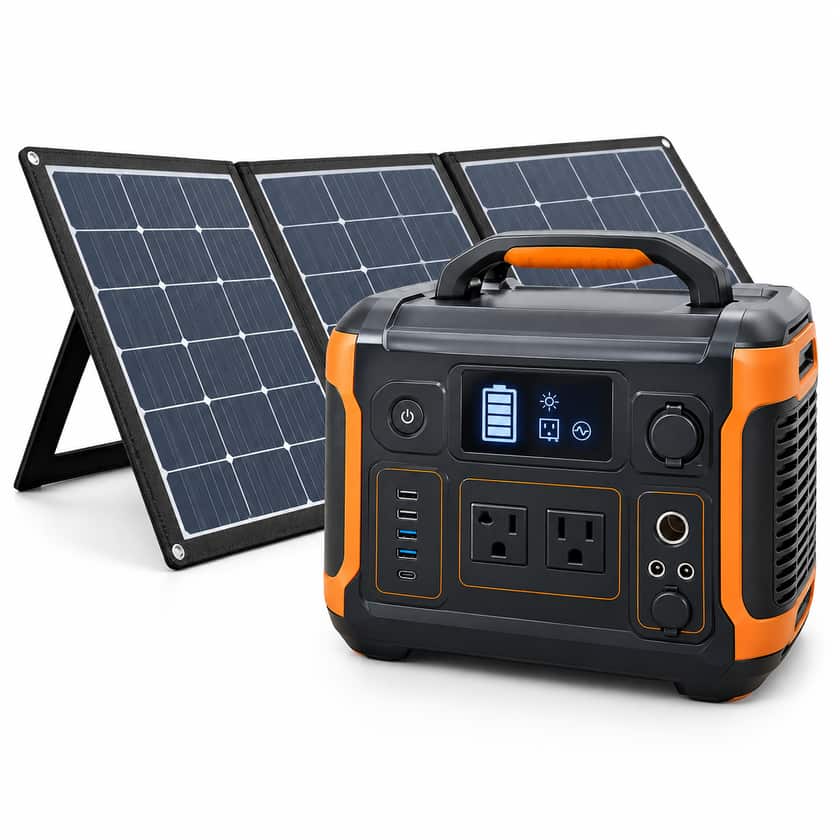
Understanding array replenishment is equally critical: What Can a 600 Watt Solar Panel Power during real-world conditions? Accounting for standard STC derating (80% yield efficiency), a 600W array produces roughly 450 to 480 true continuous watts during peak solar hours. This generation easily replenishes a 1,000Wh battery within 2.5 to 3 hours, powers outdoor 12V refrigeration continuously, recharges personal mobile electronics, and supports Starlink satellite terminals indefinitely.
Granular Breakdown & Comparison Matrix
| Strategy / Option | Price/Cost Range | Structural/Technical Efficiency | Common Hidden Pitfalls / Traps | Ideal Use-Case Scenario |
|---|---|---|---|---|
| Compact Mobile Pack (500Wh–1,000Wh) | $400 – $900 | 85–88% inverter efficiency; high mobility; weight under 25 lbs | Lacks RV TT-30 outputs; cannot sustain residential well pump surge | Overlanding, weekend tent camping, CPAP and drone field recharging |
| Mid-Tier Workhorse (2,000Wh–3,000Wh) | $1,300 – $2,500 | 88–92% efficiency; native 30A RV port; 2,400W continuous AC | Thermal throttling during sustained 20A draw; limited continuous 240V | Small RV trailer dry camping, dedicated full-size refrigerator backup |
| High-Capacity Residential Hub (5,000Wh+) | $3,500 – $6,500 | 90–93% efficiency; split-phase 240V; 1,600W+ high-voltage MPPT | Exceeds single-person mobility limits (100+ lbs); neutral bond wiring errors | Extended household blackouts, off-grid cabins, 50A RV long-term staging |
| Modular Scalable Matrix (10kWh–20kWh) | $7,000 – $15,000 | 92–94% system-wide efficiency; commercial-grade subpanel direct link | Complex subpanel installation permits; parasitic standby self-discharge | Comprehensive whole-house power resilience, mission-critical equipment |
Critical Technical Decision Parameters
- Inverter Surge Multiplier and Topology: Inductive loads (refrigerators, deep freeze compressors, sump pumps) demand surge currents 3 to 7 times higher than operational ratings. Standard modified sine wave units induce harmonic distortion, excessive heat, and motor burnout. Procure low-frequency or advanced high-frequency pure sine wave inverters carrying minimum surge ratings equal to 200% of the continuous operating capacity for at least 100 milliseconds.
- Cell Chemistry Cycle Life (LiFePO4 vs. NMC): Lithium Iron Phosphate chemistry provides between 3,500 and 6,000 full charge cycles before cell capacity degrades to 80% of nominal rating. In contrast, Nickel Manganese Cobalt (NMC) options experience degradation after 500 to 800 cycles. Stationary domestic and frequent RV systems should standardize exclusively on LiFePO4 to guarantee a 10-year service life.
- Solar PV Input Voltage Windows (VOC Limits): Solar panel performance drops significantly if string voltage mismatches internal MPPT controllers. Low-end power stations cap solar input at 60V, restricting configurations to parallel wiring that demands thick, inefficient copper gauge cables. High-tier stations support 150V to 450V inputs, enabling efficient series solar strings that generate usable harvest early in the morning and during overcast weather.
Practical Vendor & Purchase Action Plan
Four-Point Physical Inspection Checklist
- [ ] Verify Port Gauge and Terminal Quality: Inspect high-current connections (Anderson Powerpole, NEMA TT-30R, NEMA 14-50R). Ensure receptacle housings are commercial-grade polycarbonate with snug mechanical tolerances that resist lateral plug wobble.
- [ ] Check Ingress Protection (IP) Sealing: Review outer casing joints, port dust flaps, and fan grills. Outdoor expedition units need an ingress protection rating of at least IP54 to prevent fine particulate contamination and vertical water penetration.
- [ ] Confirm Ground Bonding Configuration: Use a digital multimeter or circuit analyzer to test the neutral-to-ground bond across all AC outlets. Verify whether the chassis utilizes a floating neutral or bonded neutral to align with your home transfer switch.
- [ ] Review Real-Time Cooling Fan Acoustic and Flow Profiles: Engage an inductive test load exceeding 1,500 watts. Verify that fan curves spin up smoothly without bearing rattle, and confirm warm air exhausts freely without internal component hot spots.
Vendor and Electrician Consultation Script
- "What is the continuous operational solar input wattage under a hot roof test, and does the internal MPPT controller hard-throttle amperage when panel open-circuit voltage approaches the maximum threshold?"
- "Is the alternating current inverter system configured with a floating neutral or a bonded neutral, and what specific transfer switch hardware is certified to prevent ground fault interruption tripping during domestic backup operation?"
- "Does the battery management system feature low-temperature charge cutoff sensors and cell-level heating elements to prevent irreversible lithium plating when charged below freezing?"
- "In the event of an inverter or mainboard component failure, what is the localized RMA process, and do you supply modular field-replaceable parts or require freight shipping of the entire battery enclosure?"