
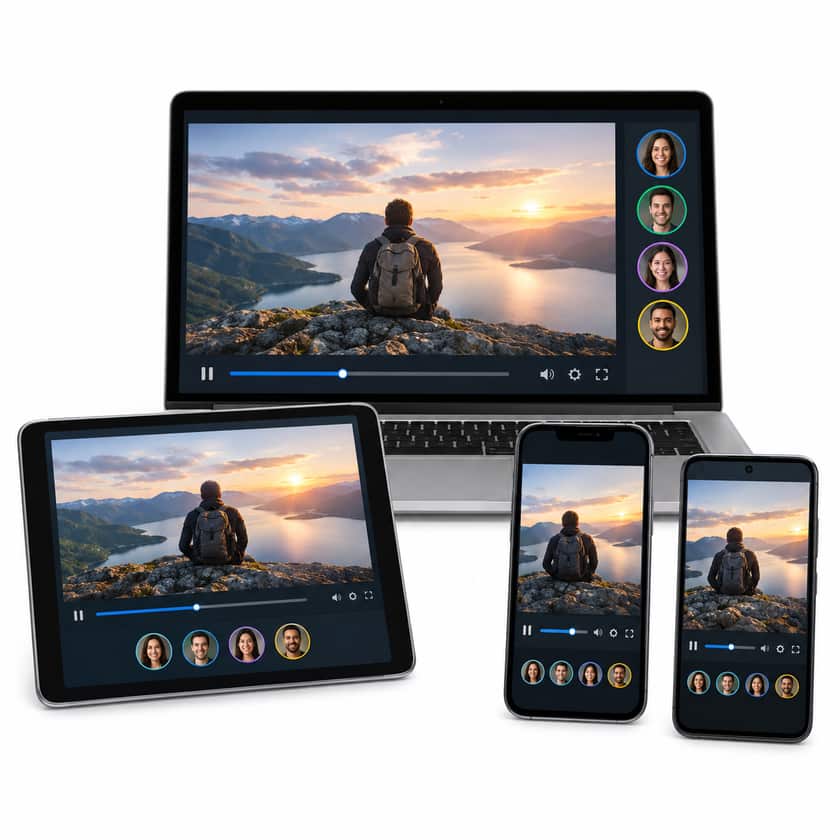
Understanding the Architecture of Synchronized Remote Streaming
Off-the-shelf consumer media streaming solutions fail when distributed groups attempt simultaneous playback across different geographic regions, bandwidth profiles, and device ecosystems. Traditional media distribution relies on client-side buffering architectures designed specifically to decouple playback from network instability. While this architecture prevents buffering interruptions for an individual viewer, it inherently destroys temporal alignment across multiple viewing endpoints. When viewers attempt manual synchronization using chat applications or countdown timers, playback offsets drift anywhere from three to forty-five seconds within minutes.
This discrepancy is not user error; it represents a structural clash between adaptive bitrate algorithms and collaborative consumption requirements. As network congestion fluctuations prompt local media players to shift between resolution ladders, individual buffer depths shift dynamically. Standard commercial video ecosystems prioritize single-viewer buffer stability over clock-synchronized frame alignment. Overcoming this requires dedicated co-watching network architectures capable of continuous clock mediation, dynamic buffer management, and cross-platform session orchestration without triggering digital rights management lockouts or server-side throttling.
Scenario-Based Solution Guides Across Core Use Cases
Overcoming Frame Drift with Synchronized Video Streaming Platforms
Distributed groups attempting remote screening sessions frequently encounter asynchronous playback drift, resulting in broken conversational context and spoiled narrative events. The standard user reaction involves manual compensation—frequently pausing, skipping backwards, or coordinating countdowns via text or voice. These makeshift compensations fail because content delivery networks dynamically adjust transport rates via HTTP Live Streaming (HLS) or Dynamic Adaptive Streaming over HTTP (DASH). Local media engines continuously expand or contract internal playback buffers based on local transit conditions, rendering manual alignment ineffective within sixty seconds of execution.
To achieve true real-time alignment across dispersed locations, specialized synchronized video streaming platforms implement WebSocket-based control planes coupled with Network Time Protocol (NTP) synchronization engines. A production-grade platform must maintain temporal drift under 250 milliseconds across all connected clients without causing persistent audio stutter. Key operational criteria include native host-driven master clock reconciliation, sub-second playback state propagation, and dynamic client-side micro-scrubbing that adjusts audio sample playback rates imperceptibly rather than executing abrupt pause-and-resume cycles.
In standard enterprise and consumer deployments, Teleparty serves as an entry-level browser extension benchmark for catalog-based subscription services, while Scener provides an integrated virtual theater environment capable of synchronizing paid streaming subscriptions alongside real-time video chat. For local media collections and self-hosted libraries, Plex Watch Together establishes an industry benchmark by leveraging direct server-client telemetry to coordinate direct-play streams across heterogeneous operating systems without cloud relay penalties.
Resolving Protocol Fragmentation with Cross-Platform Watch Party Tools
Attempting to bridge viewers across varied hardware platforms—such as smart televisions, desktop operating systems, iOS, and Android—incurs severe software incompatibility. Many secondary watch party extensions function exclusively within desktop Chromium architectures, locking out mobile users and living-room smart displays. When users attempt to circumvent these limitations by screen-sharing proprietary streaming services through general VoIP applications, digital rights management (DRM) safeguards typically trigger black-screen security interlocks or severe hardware downsampling, degrading the visual experience.
Resolving these ecosystem barriers demands dedicated cross-platform watch party tools built on universal WebRTC signaling layers or standardized platform application interfaces. Reliable solutions must negotiate Widevine, FairPlay, and PlayReady DRM compliance parameters natively on client devices while abstracting communication channels to lightweight external signaling protocols. Furthermore, multi-device ecosystems require centralized room-state serialization, ensuring that any participant joining from a mobile device or tablet assumes the precise temporal timestamp and playlist sequence established by the desktop host.
When evaluating operational standards across cross-platform environments, Watch2Gether sets a high standard for open-web media embedding without requiring client installations, while Kast demonstrates commercial streaming room versatility through specialized cloud-browser virtualization. For gaming and screen-broadcasting scenarios requiring high-resolution pass-through, Discord provides an objective performance benchmark for voice-integrated media routing, provided participants stream non-restricted video sources.
Eliminating Playback Stutter via Co-Watching Software Latency Solutions
High-latency network environments severely degrade interactive synchronized playback sessions. When participants connect across variable cellular networks, satellite uplinks, or congested residential internet service providers, synchronization commands frequently arrive out of order. Standard player implementations respond to delayed timing packets by dropping video frames, muting audio channels, or triggering repetitive buffering sequences that destabilize the entire group session.
Architectural mitigation of these latency spikes requires co-watching software latency solutions equipped with predictive jitter buffers and adaptive clock reconciliation. Rather than enforcing strict frame locks that force high-bandwidth participants to wait for congested endpoints, the software architecture must implement differential latency tiers. Under this model, signaling servers calculate individual round-trip times (RTT) via lightweight User Datagram Protocol (UDP) heartbeats, selectively delaying control signals for low-latency nodes while deploying client-side dynamic time-stretching between 0.95x and 1.05x speed variations for lagged connections to close gaps smoothly.
Within this technical category, Amazon Prime Video Watch Party provides an established consumer baseline for managed cloud synchronization, integrating dynamic adaptive bitrate adjustments to protect stream stability. For open-source video infrastructure, Syncplay serves as an authoritative desktop benchmark for managing local media timecodes across cross-country peer networks via low-overhead IRC-style protocols, ensuring precise alignment even over unstable broadband lines.
Technical Evaluation and Strategy Matrix
| Strategy / Option | Price/Cost Range | Structural/Technical Efficiency | Common Hidden Pitfalls / Traps | Ideal Use-Case Scenario |
|---|---|---|---|---|
| Browser Extension Hooks | Free – $5.00/month | High synchronization accuracy via native DOM injection; minimal CPU overhead | Fails on mobile devices; broken by upstream streaming UI updates | Desktop-focused groups watching subscription video-on-demand services |
| Cloud Virtualization Relay | $9.99 – $29.99/month | Universal platform compatibility; bypasses local client DRM issues | High upstream bandwidth requirements; noticeable compression artifacts | Mixed-device groups sharing non-standard or fragmented web media |
| Direct Server Telemetry | Free – $4.99/month | Bit-perfect native resolution; sub-100ms synchronization precision | Demands technical server setup; restricted to non-DRM self-hosted media | Enthusiasts sharing high-bitrate local libraries and home servers |
| WebRTC Screen Broadcast | Free – $9.99/month | Real-time audio and video interaction with near-zero control delay | DRM black screens; heavy client-side CPU encoding and decoding strain | Informal watch sessions for user-generated content and live gameplay |
Critical Technical Decision Parameters
Selecting an optimal synchronization deployment requires precise evaluation of three underlying performance parameters:
- Dynamic Drift Margin: System architectures must specify whether synchronization tolerance is hard (sub-50ms) or soft (250ms to 1000ms). Soft-margin systems prevent aggressive buffering loops over volatile networks, whereas hard-margin platforms are mandatory when viewers share an open microphonic voice-chat room to prevent jarring acoustic echo.
- DRM Handshake Decoupling: Evaluators must determine whether the platform synchronizes the underlying video payload directly or merely transmits temporal coordinates. Systems transmitting synchronized timecodes across native client instances maintain maximum audio-visual fidelity while eliminating intellectual property compliance vulnerabilities.
- Relay Scalability and Packet Loss Resilience: Software solutions utilizing central signaling WebSockets maintain predictable state synchronization, but client-to-client peer topologies dramatically reduce operational server infrastructure costs. Deployments operating over peer topologies require Forward Error Correction (FEC) algorithms to prevent single-participant dropped packets from stalling playback for the entire group.
Practical Vendor & Purchase Action Plan
Pre-Deployment Verification Checklist
- Audit Hardware and Browser Parity: Confirm that all participating endpoints utilize supported browser runtimes, operating system builds, or native applications capable of executing synchronized state listeners without background process throttling.
- Validate DRM Compliance and Account Requirements: Verify whether the platform requires every participant to maintain an active individual streaming service subscription, or if the system broadcasts via legalized cloud-hosted single-source instances.
- Quantify Upstream Network Headroom: Ensure host systems possess at least 15 Mbps dedicated upstream bandwidth for WebRTC-based direct broadcasting, or a minimum of 5 Mbps downstream headroom per participant for timecode-only synchronization extensions.
- Inspect Audio Routing Configuration: Confirm that voice communication channels utilize acoustic echo cancellation (AEC) and push-to-talk capability to prevent audio feedback loops generated by desktop speakers during group playback.
Vendor and Platform Consultation Script
When evaluating commercial co-watching software or enterprise-grade remote screening software, present these four precise inquiries to vendor representatives or technical support teams:
- What specific time-synchronization protocol governs cross-client playback alignment, and what is the maximum millisecond drift threshold before a forced resynchronization event triggers on lagging endpoints?
- Does your software synchronize playback by transmitting lightweight telemetry coordinates between independent authenticated accounts, or does it utilize centralized cloud-browser virtualization that re-encodes the target media stream?
- How does the client-side architecture handle transient packet loss, and does it deploy imperceptible micro-rate pitch adjustment or hard audio-video pauses to maintain session alignment?
- What specific end-user permissions, browser extension policies, or firewall port allowances are required to prevent corporate, university, or mobile broadband networks from severing signaling channels?