
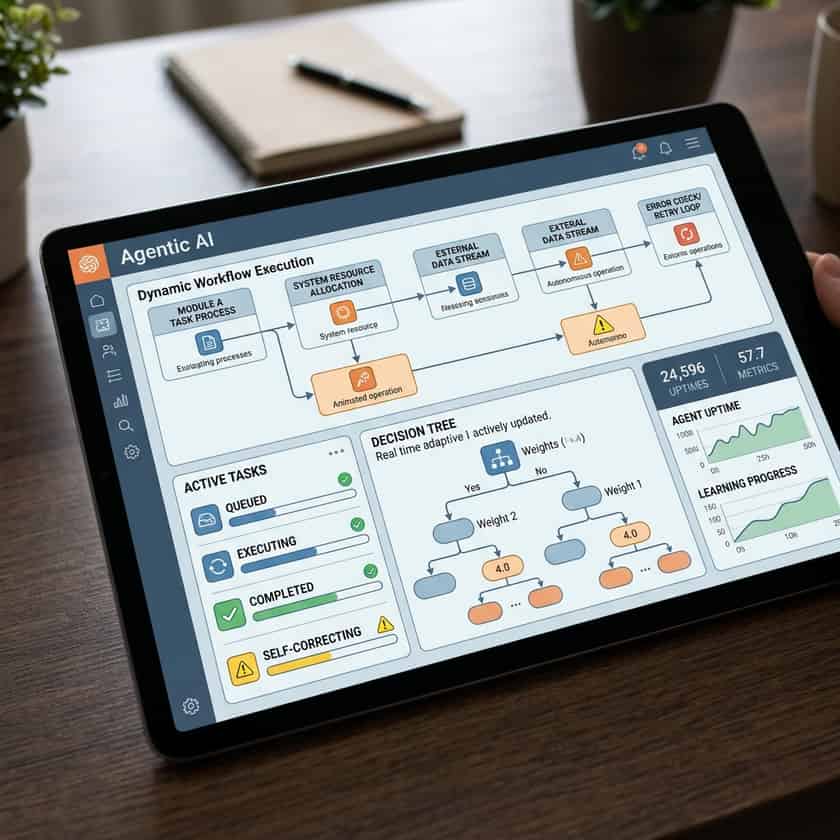
The Shift Toward True Autonomy
As we navigate 2026, the artificial intelligence landscape has moved well beyond the conversational chatbots of previous years. We are witnessing the maturation of the AI agent—a system not merely designed to respond to prompts but engineered to execute complex, multi-step tasks independently. Unlike traditional software that requires constant human oversight, these modern agents function as autonomous operators within digital environments. They leverage sophisticated reasoning models to break down high-level goals into actionable sub-tasks, prioritize their own workflows, and interact with various third-party applications to achieve desired outcomes. This evolution marks a fundamental shift in the relationship between humans and machine intelligence.
The 2026 technological paradigm emphasizes 'agentic' behavior. This means that instead of simply providing information, an AI agent can now navigate user interfaces, manipulate datasets, and negotiate contract terms within defined boundaries. The primary value proposition has shifted from generating text to generating action. Industries are rapidly integrating these systems to manage back-office logistics, customer interaction pipelines, and technical research, effectively creating a hybrid workforce where AI agents manage the routine operations while human teams focus on high-level strategic governance and creative problem-solving.
Key Use Cases Defining 2026
The practical application of AI agents in 2026 is becoming increasingly diversified across various sectors. While early adopters initially focused on simple document summarization, current deployments are deeply integrated into operational infrastructure. The most significant efficiency gains are observed in roles that require high-frequency, logic-heavy interactions. By offloading these responsibilities, enterprises are seeing a marked reduction in operational friction. These agents are not just tools; they function as digital employees capable of maintaining operational continuity across multiple time zones without fatigue or deviation from established protocols.
- Automated Procurement: Agents that monitor supply chains and automatically reorder inventory based on real-time data.
- Regulatory Compliance: Systems that continuously scan internal communications to ensure adherence to changing legal standards.
- IT Service Management: Autonomous troubleshooting agents that diagnose and resolve common network or software issues before they escalate.
- Complex Scheduling: AI systems that manage intricate team calendars across global organizations, accounting for time zone availability.
- Financial Reconciliation: Tools that compare ledger entries against transaction logs to identify and flag discrepancies automatically.
Understanding Agent Capabilities and Constraints
While the capabilities of AI agents in 2026 are impressive, understanding their limitations is vital for successful implementation. High-performing agents are built on robust, secure architectures, often utilizing fine-tuned models that prevent 'hallucinations' in critical task execution. An effective agent is limited by the quality of its instructions and the sandbox it is allowed to operate in. As these agents become more powerful, the focus has shifted toward 'guardrail' implementation—software layers that act as a safety net, ensuring the agent stays within pre-defined operational boundaries. Businesses must carefully balance the desire for autonomous speed with the necessity of human oversight.
| Feature | Traditional Automation | AI Agents (2026) |
|---|---|---|
| Workflow Structure | Hard-coded logic | Dynamic reasoning |
| Adaptability | Fixed rules | Self-correcting |
| Task Scope | Repetitive, singular | Multi-step, complex |
| Interaction | Requires input | Proactive initiation |
| Error Handling | Stops on failure | Attempts re-routing |
Strategic Implementation Frameworks
For organizations looking to integrate AI agents, the strategy for 2026 revolves around modular deployment. Rather than attempting to automate an entire business department at once, successful firms are isolating specific, high-friction tasks and assigning agents to manage these distinct processes. This modularity allows for easier monitoring and adjustment. Security remains the highest priority; agents must be implemented with strict access controls and audit trails to ensure transparency. It is recommended to start with agents that operate in read-only environments before granting them 'write' permissions for critical business databases. This incremental approach allows for fine-tuning before full-scale deployment.
Looking ahead, the next phase involves agent collaboration—multiple specialized AI agents working together to solve larger problems. We may soon see a 'project manager' agent delegating research tasks to a 'data analysis' agent, which in turn hands findings off to a 'content creation' agent. This orchestration layer is the current frontier of development. By 2027 and beyond, we expect these systems to become even more interoperable, allowing companies to stitch together workflows that span diverse software ecosystems without requiring custom integration code for every new tool they adopt.