
Understanding the Modern AI Agent
An AI agent is more than just a chatbot; it is an autonomous system capable of executing tasks, making decisions, and interacting with external environments to achieve specific goals. While large language models serve as the reasoning engine, the agent structure incorporates memory, tools, and perception to perform real-world functions. Organizations today are increasingly turning to these agents to streamline repetitive workflows, manage complex data pipelines, and improve operational efficiency across digital platforms. The shift is moving from passive content generation to active task completion, where the agent functions as a silent, digital employee.
Defining Your Use Case and Architecture
Before you begin development, defining the scope is critical. A well-designed agent often focuses on a narrow set of tasks rather than trying to mimic general human intelligence. Developers must decide on the underlying architecture: will the agent rely on a persistent memory store to recall past interactions, or will it be stateless? Successful implementations often utilize a modular approach, where the LLM is decoupled from the execution layer. This allows for swapping out models as new, more cost-effective versions are released, without needing to rewrite the entire backend logic that interfaces with your specific enterprise applications or databases.
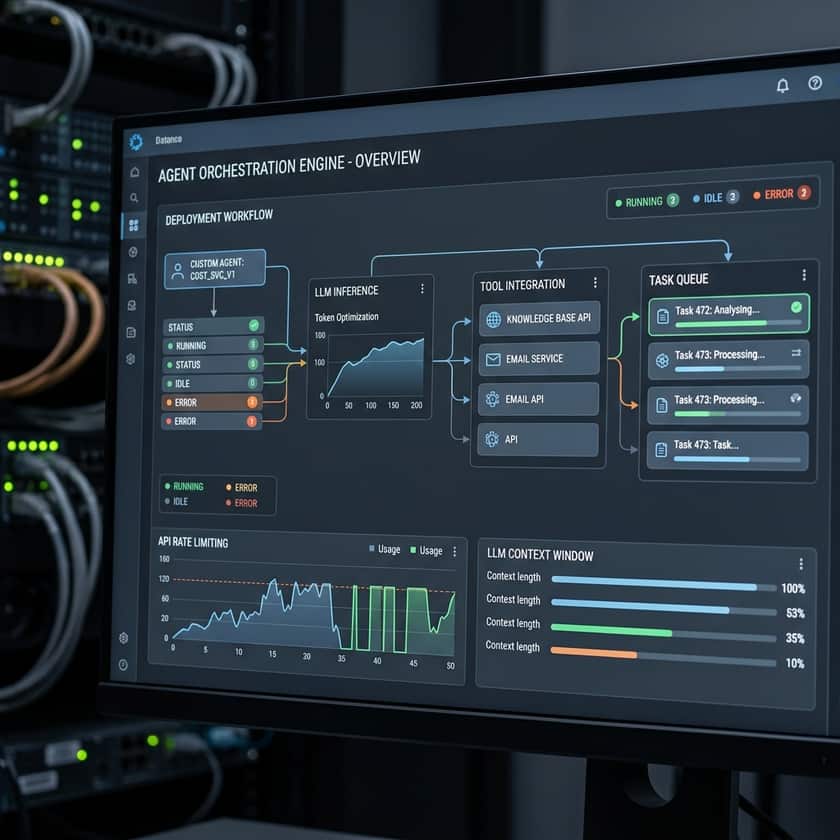
Automation pipelines are the backbone of any reliable AI agent. These pipelines manage the flow of data between the AI engine and the tools it controls. For example, if an agent needs to retrieve information from a CRM and update a calendar, the pipeline handles the authentication, API rate limiting, and data transformation. Ignoring these foundational elements usually leads to fragile systems that break whenever an external service updates its interface or API structure. Focusing on robust error handling and logging from the start ensures your agents stay operational even when minor system changes occur.
Managing Operational Costs and API Usage
Cost management is the single most important factor in the long-term viability of an AI agent project. Most development frameworks charge based on token usage or the number of API calls made to the underlying model. Complex agentic reasoning—where the agent loops through thoughts, actions, and observations multiple times—can cause costs to escalate rapidly if not throttled. It is essential to monitor your consumption metrics daily. Implementing caching strategies for frequent queries and setting hard spending limits on your cloud API provider are non-negotiable best practices for avoiding unexpected monthly bills.
| Architecture Type | Agent Complexity | Est. API Calls/Run | Cost Level | Scaling Capacity |
|---|---|---|---|---|
| Stateless Basic | Low | 5-10 | Low | High |
| Context-Aware | Medium | 20-40 | Moderate | Moderate |
| Autonomous Swarm | High | 100+ | High | Low |
Best Practices for Implementation and Auditing
- Establish an audit trail that logs every decision made by the agent for compliance and debugging purposes.
- Implement human-in-the-loop verification steps for critical tasks that involve external communications or financial transactions.
- Grant the agent the principle of least privilege, providing access only to the specific APIs it needs to perform its assigned duties.
- Check system logs at least once a day to identify potential loops or excessive token usage before costs spiral.
- Schedule regular maintenance updates to the prompt templates, as model behavior can shift over time as new versions are released.
Continuous improvement is the final phase of the development lifecycle. Once an agent is live, you will inevitably discover edge cases where the agent hallucinates or fails to complete a task. Rather than manually intervening every time, build a feedback loop where failures are caught and used to refine the instructions or the context provided to the agent. This iterative process turns a basic script into a sophisticated, self-correcting system. By focusing on modularity, strict cost controls, and thorough auditing, you can build AI agents that provide tangible value without overwhelming your development budget or introducing unnecessary operational risk to your organization.