
The Rise of Autonomous Commerce Agents
In the rapidly evolving landscape of modern retail, the ability to respond to customer needs in real-time is a significant competitive advantage. Building your own AI agent for ecommerce is no longer a futuristic concept reserved for tech giants; it has become an accessible reality for businesses of all sizes. By leveraging sophisticated large language models and automation frameworks, store owners can deploy agents that handle everything from product recommendations to complex troubleshooting inquiries. These agents act as a digital layer between your catalog and your customers, functioning 24/7 to ensure that no interaction is left unanswered, regardless of the time or volume of traffic.
The primary goal when creating an AI agent is to bridge the gap between static website data and dynamic customer intent. Unlike a simple chatbot that relies on rigid decision trees, a well-architected AI agent understands context. If a customer asks about a specific return policy or product compatibility, the agent processes the query using your internal documentation, providing accurate, brand-aligned responses. By focusing on integration with existing platforms—such as Shopify, WooCommerce, or enterprise-grade ERP systems—businesses can transform their online storefronts into conversational, high-converting environments that operate with minimal human intervention.
Core Components of a Successful AI Agent
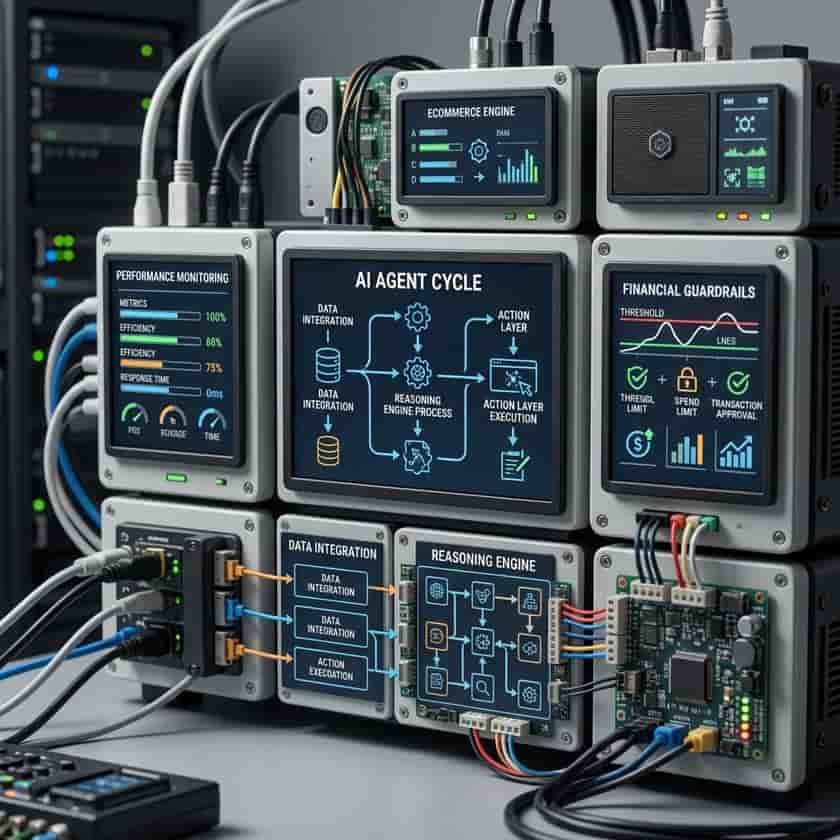
When you begin to build your own AI agent, it is crucial to recognize that the brain of your operation consists of three main elements: the knowledge base, the reasoning engine, and the action layer. The knowledge base should contain your product data, FAQs, and policy documents, while the reasoning engine interprets customer inputs. Perhaps most importantly, the action layer allows the agent to actually perform tasks. This might mean initiating a refund, updating a shipping address, or applying a discount code based on a customer's loyalty tier. Without a clear action layer, an AI agent is just a passive information lookup tool rather than an active assistant.
To achieve high performance, many developers aim for latency levels of around 1.5 seconds or less for initial response times. If the user experience is sluggish, customers will quickly disengage. Achieving this speed requires optimized hosting and efficient prompt engineering. Furthermore, the accuracy of your agent is paramount. By implementing Retrieval-Augmented Generation (RAG), you ensure the AI pulls information only from your verified business data. This drastically reduces the likelihood of hallucinations, where an AI might invent policies that don't exist, and ensures the agent remains a reliable representative of your brand's voice and professional standards.
Establishing Necessary Guardrails
Security and trust are the foundations of any automated system. When you build your own AI agent for ecommerce, you must implement strict guardrails to prevent unauthorized actions or unintended disclosures. For instance, if you allow your agent to auto-approve refunds, you must set financial limits to protect your margins. A common best practice is to set a threshold—such as 50 euros—where anything below this amount is handled by the AI, but anything above requires manual human review. This ensures that your automation scales effectively without creating significant financial risk for your store, balancing operational efficiency with fiscal prudence.
| Action Type | Mechanism | Trigger/Cap |
|---|---|---|
| Refund Request | Auto-Approval | Under €50 |
| Refund Request | Manual Review | Over €50 |
| Order Cancellation | Automated | Before Shipping |
| Address Change | Automated | Before Label Generation |
Scaling Through Strategic Automation
As your business grows, your AI agent should scale with you. A major advantage of these systems is their ability to handle 80% of common customer inquiries without human intervention. By analyzing interaction logs, you can identify the most frequent questions and train your agent to handle them with higher precision. This leaves your human support team available to focus on the remaining 20% of complex cases that require empathy, nuance, and critical thinking. This hybrid approach—combining machine speed with human insight—is the hallmark of a mature, data-driven ecommerce operation that effectively manages customer satisfaction and operational costs.
- Maintain sub-1.5 second latency for customer-facing responses.
- Set strict financial guardrails, such as a 50 euro cap for auto-approvals.
- Aim for an 80% resolution rate on routine queries.
- Regularly review agent logs to identify and patch knowledge gaps.
- Ensure all agent responses verify against your internal documentation.
As we look toward 2026 and beyond, the integration of AI agents will move from being a 'nice-to-have' to an industry standard. Businesses that take the time to build their own systems now will have a significant advantage in gathering data, refining their models, and creating personalized experiences that keep customers returning. It is not just about replacing support staff, but about enhancing the capabilities of your existing team. When you enable your support agents with AI-driven insights, they become faster and more effective, transforming the support department from a cost center into a powerful growth engine that drives customer lifetime value.