
Defining the Modern AI Agent
For years, the public perception of artificial intelligence has been dominated by chatbots—systems designed to answer questions or generate text based on prompts. However, the industry is shifting toward a more sophisticated concept: the AI agent. Unlike a standard chatbot that waits for human instruction before generating a response, an AI agent acts as a proactive digital worker. These systems are designed to operate with a degree of autonomy, interpreting goals, planning necessary steps, and executing actions across various digital environments. They act as the bridge between large language models and real-world tools, allowing for complex task completion without constant human intervention.
The primary distinction between a chatbot and an AI agent is the ability to interact with external systems. While a chatbot processes linguistic data, an agent can initiate a process. For example, if you ask a chatbot about your bank balance, it might generate text explaining how to check it. An AI agent, if granted the appropriate permissions, can log into your banking interface, retrieve the actual balance, and present it to you—or even flag an error if the numbers do not align. This capacity to act behind the scenes makes them significantly more powerful than the conversational interfaces we have grown accustomed to using.
How AI Agents Function in Practice
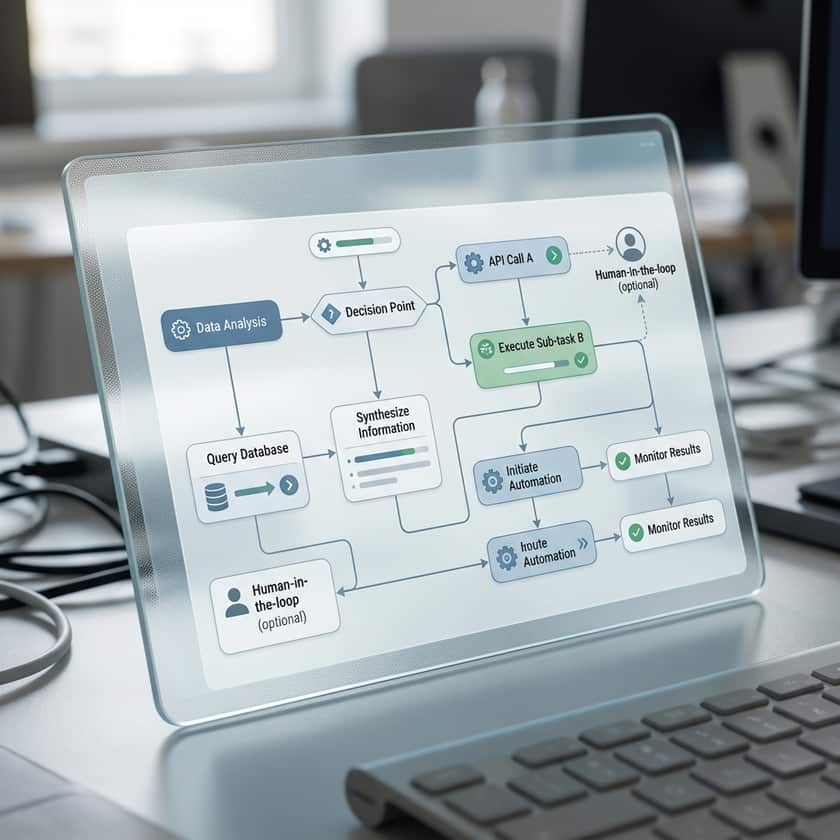
At the core of an AI agent lies a reasoning engine—often a large language model—that breaks down complex requests into a series of actionable steps. When a user assigns a goal, such as 'organize my business trip,' the agent does not merely suggest a list of hotels. Instead, it systematically browses flight options based on preferences, checks calendars for conflicting meetings, selects booking windows, and drafts the necessary reservations. This process requires the agent to understand context, maintain state throughout the interaction, and use specific digital tools to accomplish the task successfully.
- Perception: The agent analyzes the user request and identifies the intent behind the query.
- Planning: The system breaks down the goal into a sequence of smaller, logical steps or sub-tasks.
- Tool Selection: The agent determines which specific applications or APIs are necessary to perform each sub-task.
- Execution: The agent performs the action within the external environment, such as sending emails or filing reports.
- Verification: The agent reviews the outcome to ensure it meets the initial criteria and corrects errors if needed.
- Refinement: The system updates its internal state to reflect the completion of the task.
Key Use Cases for Autonomous Agents
The potential applications for AI agents are broad, moving beyond simple information retrieval into genuine workflow automation. In professional settings, AI agents are increasingly utilized to handle repetitive administrative tasks that currently consume significant time. By offloading scheduling, data entry, and basic customer correspondence, businesses can allow employees to focus on more complex, creative, and human-centric responsibilities. The impact is seen in increased operational efficiency, where agents can manage entire workflows with minimal oversight, provided they have clear instructions and adequate safety protocols in place.
| Sector | Agent Function | Key Benefit |
|---|---|---|
| Customer Support | Automated ticketing and resolution | Faster response times |
| Finance | Expense tracking and reconciliation | Reduced manual error |
| Software Development | Code testing and bug identification | Faster release cycles |
| Operations | Calendar and supply coordination | Improved logistical flow |
| Research | Data synthesis and report creation | Information efficiency |
Safety, Transparency, and Human Oversight
As AI agents gain the ability to perform tasks like sending emails or making transactions, safety becomes the paramount concern. Many developers are implementing 'human-in-the-loop' systems, where the agent proposes a plan and waits for user approval before executing high-stakes actions. For instance, an agent might draft an email or a payment, but a final click is required by a human user to verify the action. This creates a critical layer of confidence, ensuring the AI does not deviate from its intended goal or cause unintended consequences due to misinterpretation.
Transparency is another vital component of successful AI agent deployment. Users need to understand what the agent is doing and why. Systems often feature a status interface that allows users to monitor the agent's progress in real-time. If an agent hits an obstacle, it should be able to communicate the problem clearly rather than simply failing or continuing with incorrect data. By maintaining this level of clear communication, the technology functions as a helpful collaborator rather than a 'black box' that performs inexplicable actions, building trust between the user and the digital assistant.