
The Transition from Chatbots to Autonomous Agents
For years, artificial intelligence was largely associated with passive tools like search engines or conversational chatbots that could answer simple questions. Today, we are witnessing a significant paradigm shift toward AI agents. Unlike traditional AI models that wait for a user prompt to perform a single, isolated task, an AI agent is designed to act autonomously toward a specific goal. Think of these agents as digital employees capable of reasoning, planning, and executing sequences of actions across multiple applications without constant human intervention.
The primary differentiator is agency. Where a standard large language model simply provides information, an agent uses tools—such as web browsers, email clients, or specialized software APIs—to actually complete a workflow. For instance, while a chatbot might explain how to book a flight, an agent can navigate the website, select the seat, process the payment, and confirm the reservation. This shift marks the transition from AI as a knowledge repository to AI as a functional member of a workforce.
Core Capabilities of Modern AI Agents
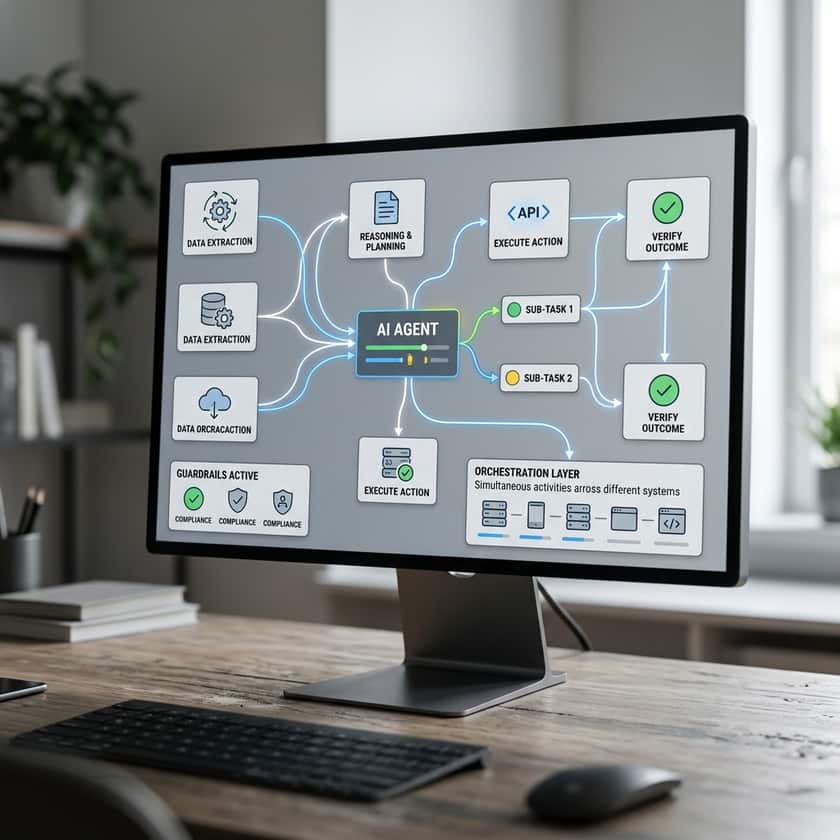
To be truly effective, an AI agent must possess a suite of sophisticated capabilities. It is not enough for an agent to merely read text; it must understand the environment in which it operates. This involves perception, which allows the agent to ingest data from various inputs, and reasoning, which enables the agent to decompose a high-level goal into a sequence of smaller, manageable tasks. For example, a customer service agent must be able to verify account status, cross-reference purchase history, and initiate a refund, all while maintaining a coherent dialogue with the user.
- Goal Decomposition: Breaking complex projects into actionable steps.
- Tool Usage: The ability to interact with external software and APIs.
- Memory Management: Retaining context from previous interactions or historical data.
- Error Handling: Self-correcting when an action does not yield the expected result.
- Continuous Monitoring: Operating in the background until the objective is met.
Primary Benefits for Business Operations
The integration of AI agents offers substantial benefits, particularly regarding operational efficiency. By automating repetitive or highly manual workflows, businesses can reallocate human talent to higher-value creative and strategic tasks. Agents are particularly adept at scaling operations; they do not experience fatigue and can operate 24 hours a day, seven days a week. This availability ensures that critical processes—such as lead qualification or technical support triaging—continue even when human teams are off the clock, providing a consistent experience for global customers.
| Feature | Traditional Chatbot | Autonomous Agent |
|---|---|---|
| Primary Goal | Answering queries | Completing workflows |
| Human Input | Continuous guidance | High-level objectives |
| Tool Usage | Limited/None | Advanced API/Browser |
| Autonomy | Low | High |
The Challenge of Reliability and Safety
Despite the potential, deploying AI agents carries distinct risks that must be managed with care. Because agents are given the authority to interact with external tools, they must operate within strict safety guardrails. An agent that lacks proper validation could inadvertently send incorrect emails, process faulty transactions, or expose sensitive data. Organizations must implement rigorous testing and 'human-in-the-loop' protocols during the deployment phase, especially for tasks involving financial transactions or customer personal data. Ensuring the agent behaves predictably and adheres to corporate policy is non-negotiable.
To mitigate these risks, developers are increasingly focused on transparency. This means maintaining detailed logs of an agent's reasoning process. If an agent fails to achieve a goal, administrators should be able to audit the specific steps it took, identifying the point where the logic diverged from the intended outcome. By combining robust logging with clear, predefined boundaries, businesses can leverage the power of agents while minimizing the likelihood of cascading errors or unintended system behaviors in production environments.
The Future Outlook for AI Agent Adoption
As the technology matures, we can expect AI agents to become increasingly specialized and collaborative. In the near term, we will likely see the rise of multi-agent systems, where different agents with specific skills communicate to solve complex problems together. For example, a research agent could gather data and pass it to a writing agent, which in turn hands it to an approval agent. This collaborative ecosystem will likely transform how we work, effectively turning individual workers into managers of their own digital agent teams.