
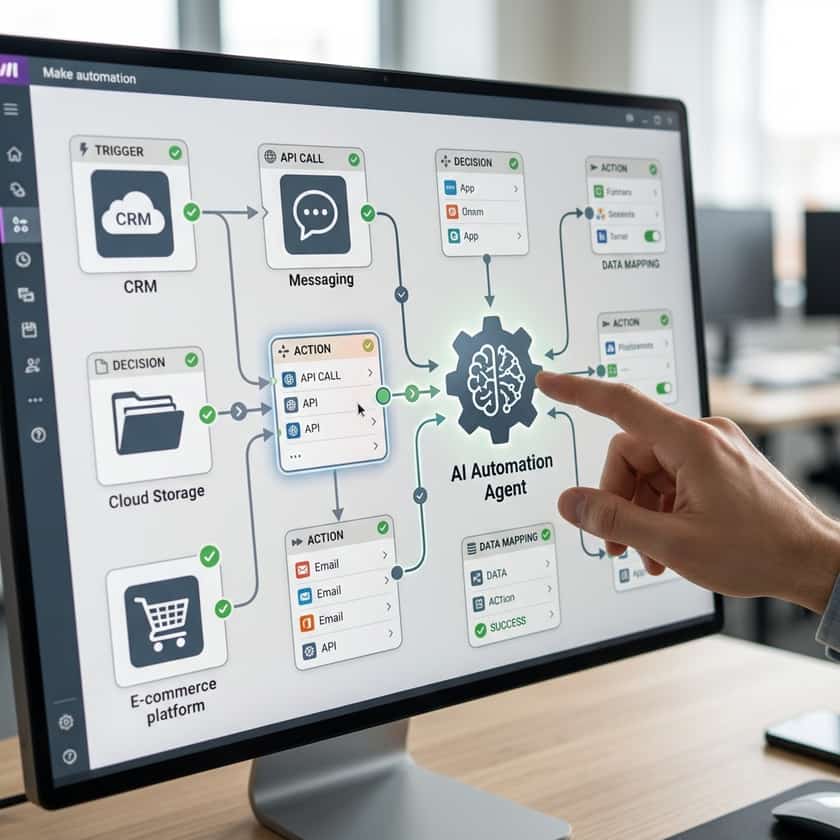
The Evolution of Workflow Automation
In the modern digital landscape, the phrase 'make AI automation' has shifted from a buzzword into a strategic necessity for businesses of all sizes. As of 2025, enterprise leaders have recognized that traditional automation is no longer sufficient to handle the complexity of global data and interactions. The current wave of AI-based automation moves beyond simple, linear 'if-this-then-that' scripts to embrace agentic architectures. These systems are capable of making decisions, context-aware reasoning, and handling multi-step tasks that previously required human intervention. By integrating AI models directly into existing application stacks, companies are effectively scaling their capacity to manage customer queries, backend logistics, and complex decision-making processes without linear scaling of their human workforce.
Understanding Agentic Workflows
At the core of contemporary automation lies the rise of autonomous agents. Unlike basic bots that perform rigid, pre-programmed actions, agents are adaptive. They analyze incoming data, determine the intent behind a request, and select the appropriate tool or application to resolve it. This paradigm shift means businesses can now deploy automation solutions that handle ambiguity. For example, a customer support agent might automatically analyze an email for sentiment before deciding whether to route it to a human manager or draft a polite, helpful response directly. This capability significantly changes how organizations approach productivity, allowing teams to move away from mundane repetitive tasks and focus on creative or high-value initiatives.
Tangible Benefits and Operational ROI
Quantifying the impact of AI automation is crucial for securing budget and management buy-in. Organizations that successfully implement these solutions often see drastic reductions in manual labor hours. In highly repetitive sectors—such as insurance or brokerage services—automation has been shown to save tens of thousands of hours annually. By reducing the clock-time associated with claims processing, companies can achieve multi-million dollar annual savings. These benefits are not merely theoretical; they are reflected in operational efficiency improvements where thousands of manual clicks are replaced by background logic, allowing for faster processing speeds and a significant reduction in error rates related to human fatigue.
| Industry Segment | Manual Hours Saved | Yearly Cost Savings |
|---|---|---|
| Claims Processing | 44,000 | $6.9 Million |
| Brokerage Operations | 29,000 | $4.8 Million |
| Customer Support | 38,000 | $5.2 Million |
Security and Compliance in the AI Era
When choosing an automation platform, security cannot be an afterthought. Enterprise-grade AI solutions must provide rigorous controls to ensure data privacy and confidentiality. Whether dealing with financial records or sensitive client communications, the best automation platforms provide audited environments. Look for vendors that explicitly list their compliance badges, such as SOC certifications, which prove that the platform undergoes regular, rigorous testing to protect user data. This level of trust is essential when handling third-party integrations, as each 'agent' within your system effectively acts as a window into your proprietary data and enterprise operations.
- Audited infrastructure to ensure data confidentiality.
- Compliance controls including SOC 2 Type II reports.
- Encryption standards for both data at rest and in transit.
- Granular permission settings for every automation agent.
- Audit logs that track every action taken by an AI model.
Implementation Strategy: Best Practices
Designing an AI-driven workflow starts with identifying the bottleneck, not the technology. Many teams make the mistake of adding AI to a process that is already broken. Instead, begin by auditing your existing workflows to see where manual interaction occurs most frequently. Once you have identified these high-friction points, you can begin to integrate AI-based tools. For instance, you might use a Large Language Model (LLM) to summarize massive amounts of data from various apps, then use automation tools to pipe that summary into your project management software. Start small, validate the results, and then scale the complexity of your agents as your team grows more comfortable with the technology.
- Audit current manual bottlenecks across departments.
- Choose AI models (like Claude or Google's options) that fit your specific use case.
- Map the inputs and outputs needed for your workflow.
- Build a pilot program for one specific, low-risk process.
- Monitor the agents closely and refine their instructions to improve accuracy.